
Crawford County Arrest Records and Court Charges
A Crawford County arrest record is the account of an arrest itself. It shows who was taken into custody, which agency made the arrest, and the booking details logged at the jail. An arrest can happen with a warrant or without one. That record starts on the law enforcement side, with the deputy or officer who made it and the jail that books the person in. A booking entry is not yet a charge. A charge only exists once a prosecutor reviews the case and formally accuses the person of a crime.
The court charge record is a separate file. After an arrest, the county prosecutor decides whether to file charges and which crimes to list. Those charges are filed with the court clerk and tracked through the case from start to finish. Booking and custody detail sit with the sheriff, so the jail roster and intake information appear on the Crawford County inmate records page. The full case file, with pleas, hearings, and the final outcome, is kept as the criminal court record. The charges after arrest sit in the middle, between the booking and the final result.
The Crawford County Sheriff runs the jail where arrested people are booked, and the office describes its role on the county sheriff office page.
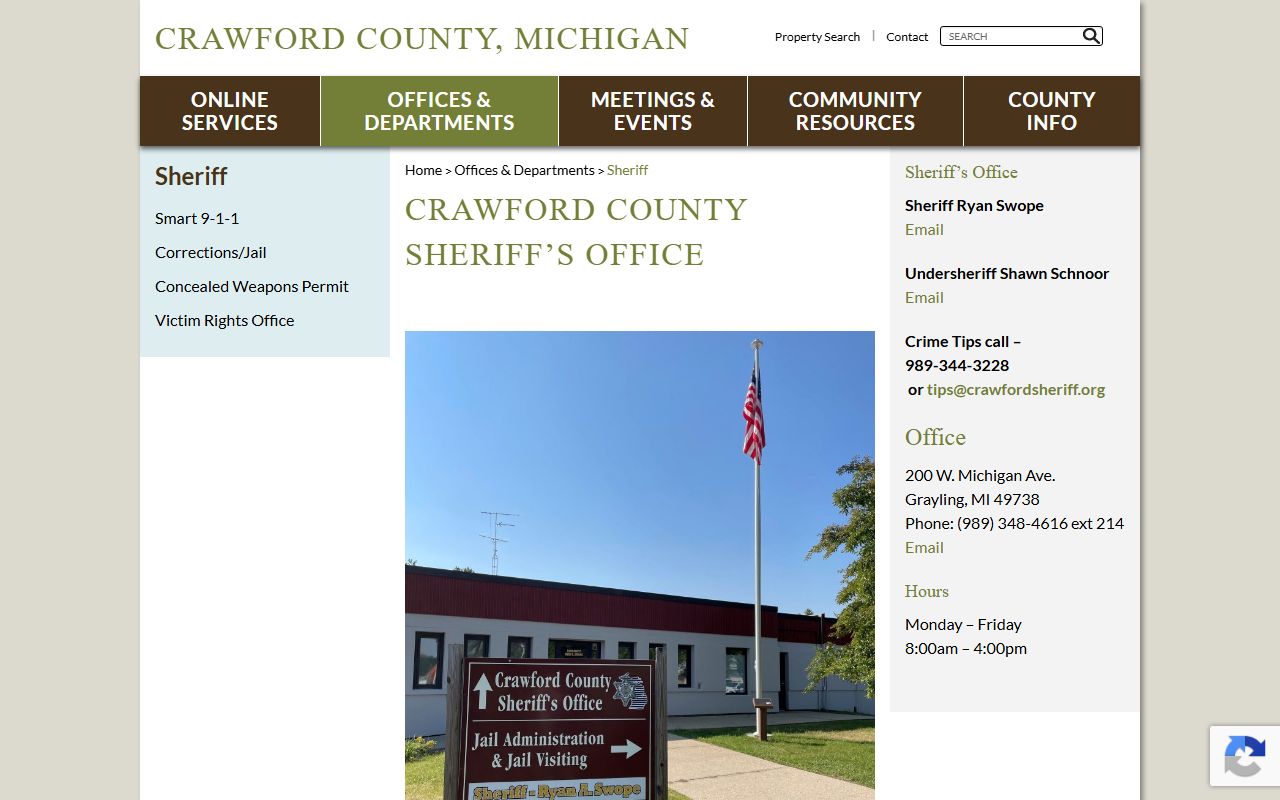
Booking sits on the sheriff's side of the process, which is why arrest and custody detail begin there rather than in the court charge file.
How to Find Crawford County Arrest Records and Charges
Court charges are found through Michigan's statewide case search. The MiCOURT system covers circuit, district, and probate cases across the state, and Crawford County charges appear there under the 46th Circuit and 87-C District Court. The portal is the fastest way to open a case and read the charge list. Booking and custody detail are not in the case search; those come from the jail itself. For the arrest record proper, start with the sheriff and jail, then use the court search to follow the charges.
- Open the MiCOURT case search and pick the Crawford County circuit route for felonies or the district route for misdemeanors.
- Search by defendant name, or enter the case number if you already have it.
- Open the case and read each charge as the prosecutor filed it.
- Check every charge for its statute code, severity level, and current status.
Not every record is online. Older or paper files may need a call to the district court clerk at 989-344-3242, or a records request to the county under the state Freedom of Information Act. The county's legacy court site still shows how these searches were organized, on its legacy court home page.
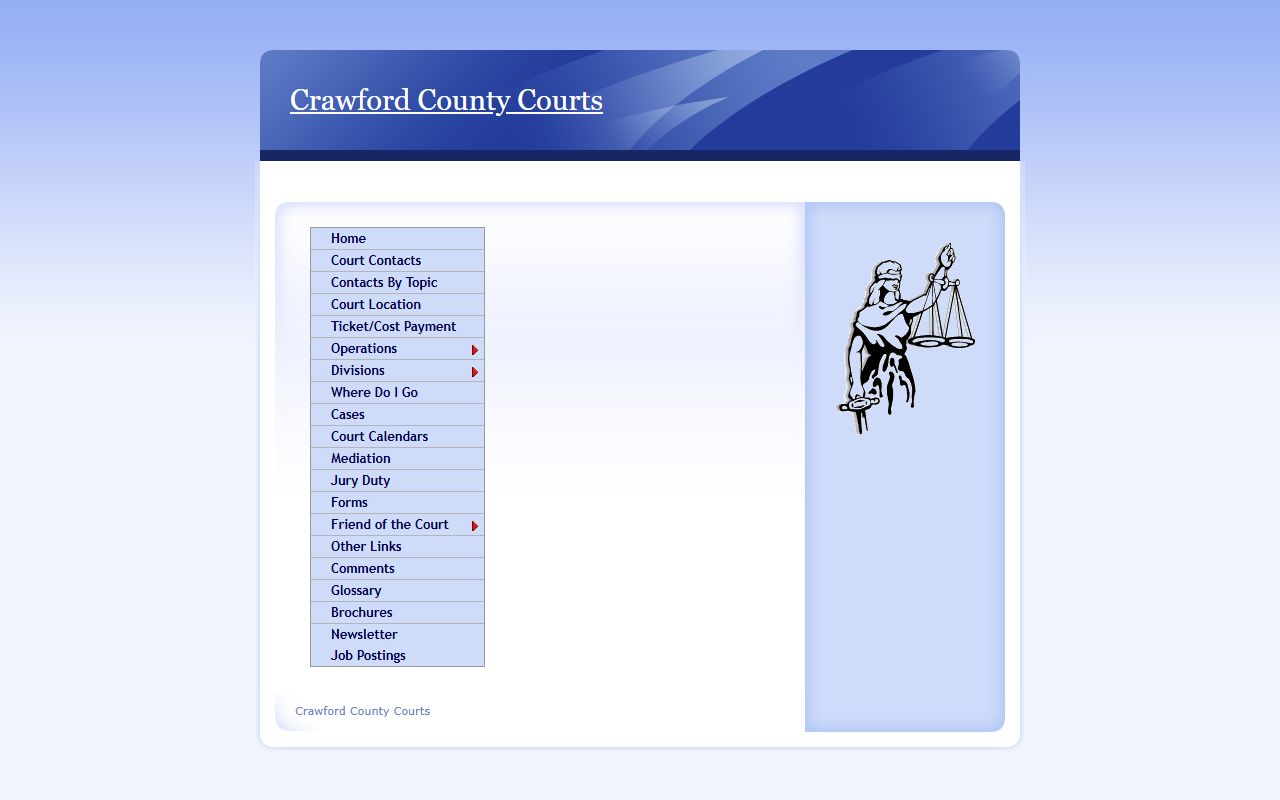
That older page helps a reader see which court division likely holds a charge before running a name search.
How Charges Get Filed After an Arrest
The charge record begins with a charging document. After an arrest, the case goes to the Crawford County Prosecuting Attorney, who reviews it and decides whether the evidence supports a charge. Prosecuting Attorney Sierra R. Koch and Assistant Prosecuting Attorney Dana Chadee review, authorize, and prosecute both felony and misdemeanor charges. Nothing becomes a formal court charge until that office signs off. When it does, the charge is filed on one of three documents.
| Complaint | Information | Indictment | |
|---|---|---|---|
| What It Is | A sworn accusation that starts a case | A formal charge filed after a preliminary exam | A charge voted by a grand jury |
| Filed By | Officer or prosecutor | Prosecutor | Grand jury |
| Common For | Misdemeanors and first felony charges | Felonies bound over to circuit court | Serious felonies, used rarely here |
Most cases open with a complaint. A felony complaint moves through the district court for arraignment and a preliminary examination before it reaches the circuit court on an information. An indictment from a grand jury is far less common at the county level. The office lists its full duties on the county prosecuting attorney page.
Misdemeanor and Felony Charge Paths
Where a charge is heard depends on how serious it is. The 87-C District Court handles misdemeanor charges and the first stage of every felony, including the arraignment. Felony charges do not stay in district court. After a preliminary examination, a felony binds over to the 46th Circuit Court for trial. Bindover simply means the case moves up to the higher court once a judge finds enough evidence to proceed.
The two levels carry very different stakes. A misdemeanor is the lower class of crime, and a felony is the more serious one. District probation staff supervise many defendants and prepare presentence reports that help the judge set a penalty after a conviction. Those reports weigh the charges and the person's history before any sentence is fixed.
The district court's probation unit explains its supervision and presentence work on the county probation services page.
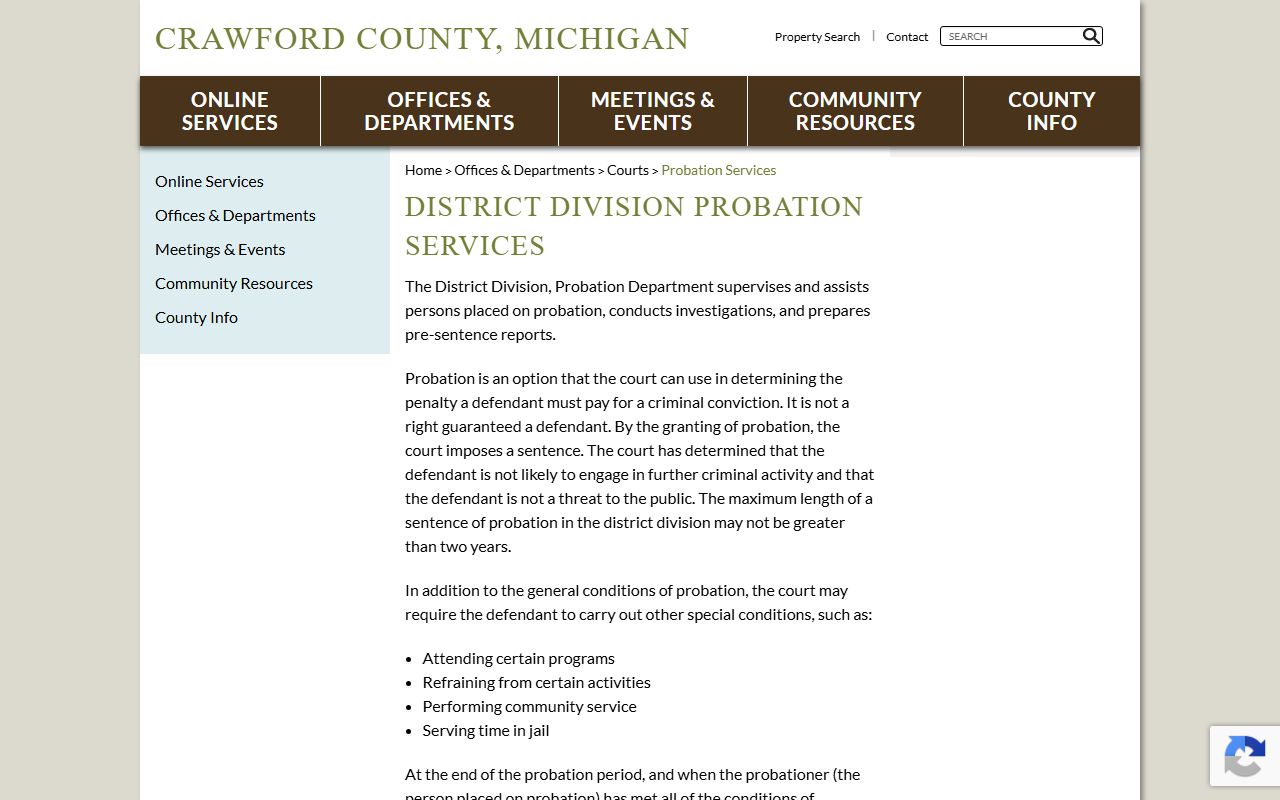
Probation enters the picture after a charge leads to a conviction, not at the arrest stage.
Charge Status and What It Means
A charge is not fixed once it is filed. As a case moves, the prosecutor can amend, reduce, add, or drop charges, and a judge can dismiss them. The status field on each count tells you where it stands right now. Reading that field matters, because a charge listed at filing can look very different by the time the case ends.
| Status | What It Means |
|---|---|
| Pending | The charge is filed and the case is still open, with no final ruling yet. |
| Amended | The prosecutor changed the charge, often to fit the evidence or a plea. |
| Reduced | The charge was lowered to a less serious offense, such as a felony cut to a misdemeanor. |
| Dropped | The prosecutor chose not to pursue the charge, so it is no longer active. |
| Dismissed | A judge threw out the charge, ending it without a conviction. |
| Nolle Prosequi | A formal notice that the prosecutor will not prosecute the charge. |
Note: A dropped or dismissed charge still appears in the public case file, so seeing a charge listed does not mean the person was convicted of it.
Charge Codes and Severity Levels
Every charge points back to a specific law. The charging document lists the statute or local ordinance the prosecutor says was broken, along with the offense name and its class. Michigan sorts offenses into felonies, misdemeanors, and civil infractions. A felony is punishable by more than a year in state prison, a misdemeanor by up to a year in county jail, and a civil infraction carries fines rather than jail. One arrest can produce several separate charges, each with its own code and status.
The county's legacy court pages map how different case types route through the local courts, including the civil matters page.
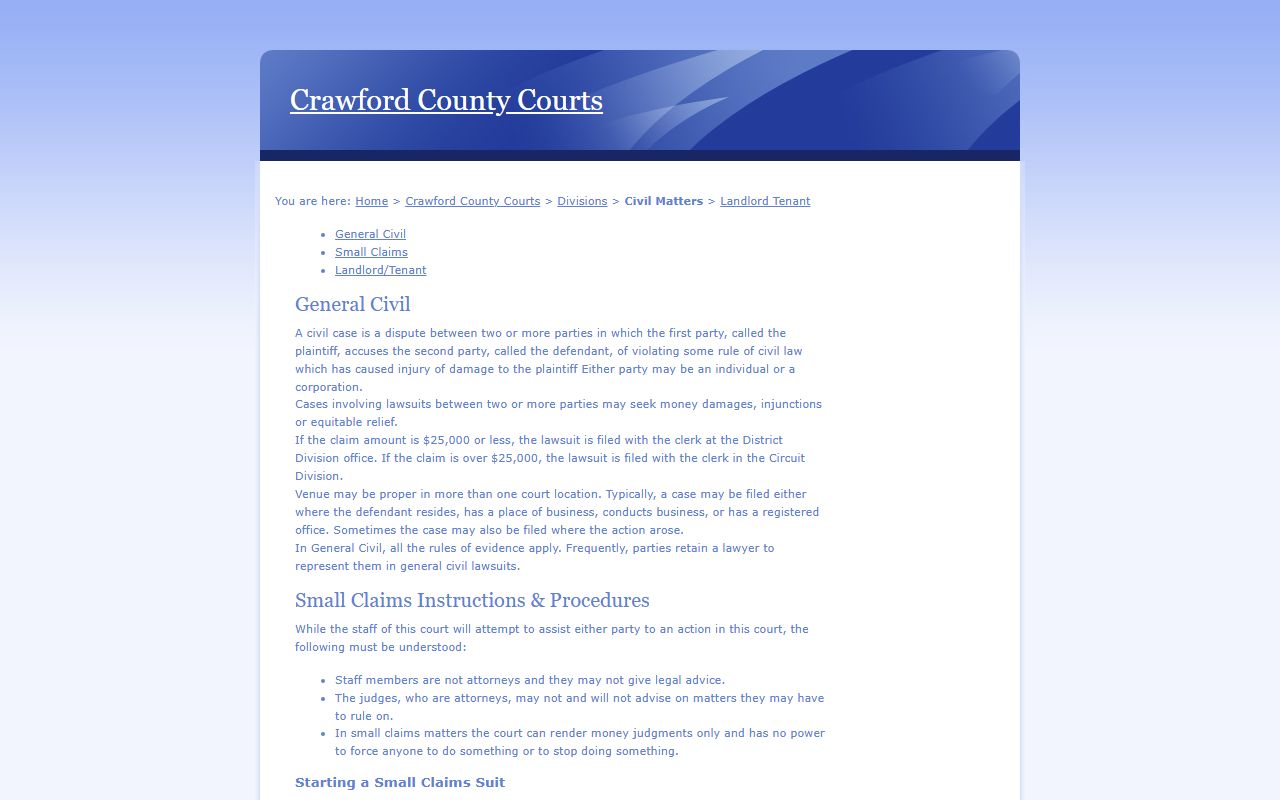
Charge class decides the path. Minor matters and infractions stay low in the system, while felonies climb to the circuit court.
Charges vs. Convictions
A charge is an accusation, not a finding of guilt. Being charged means the prosecutor believes there is probable cause to proceed. A conviction is a legal ruling of guilt, entered by a plea or reached after a trial. The two often get confused, yet they sit far apart on the case timeline. An arrest record and a charge record can both exist for a case that never ends in a conviction.
| Charge | Conviction | |
|---|---|---|
| Stage | Accusation filed | Verdict or plea entered |
| Who Decides | The prosecutor | The judge or jury |
| Burden of Proof | Probable cause | Beyond a reasonable doubt |
| Public Record | Yes | Yes |
The outcome of each charge is recorded in the case disposition, count by count, in the criminal court file. That is where a reader learns whether an accusation ended in a conviction, a dismissal, or an acquittal.
Statewide Charge and Criminal History Lookups
Charges filed in Crawford County can also surface in statewide systems once a case reaches a certain stage. The Michigan Department of Corrections runs OTIS, which tracks people sentenced to state prison, parole, or probation. The state keeps a public sex offender registry for qualifying convictions. For custody alerts and case updates, VINE notifies registered users about an offender's status.
None of these replace the county case search. OTIS shows people already under state supervision, not someone newly arrested and held before trial. The registry lists only certain convictions. For a current, local charge, the court case search and the county offices stay the primary sources.
Note: OTIS and VINE track people already in the state system, so a brand-new county arrest may not appear in them for some time.
Requesting Charge Records and Copies
A copy of the charge record can be viewed online, but a certified copy comes from the court clerk. Certified copies carry the clerk's seal and are the version courts and agencies accept. When a file is old or not digitized, the fallback is a request to the county under the state Freedom of Information Act. That law sets when a county must release a record and what it can charge for the work.
The county's legacy court site outlines how filings and payments were handled, on its filing and payments page.
Court costs and filing steps connect to the same case file where the charges are recorded, so both live under one case number.
Restricted Charge Records in Crawford County
Not every charge record is open to the public. Michigan shields several categories from a routine search. Juvenile charge records are the clearest example, held apart under state law and rarely open to the general public.
- Juvenile charges, controlled by MCL 712A.28.
- Set-aside convictions under MCL 780.621, removed from public court access.
- Sealed files where a judge has restricted access to a case or item.
- Charges tied to an active, ongoing investigation.
A set-aside does not erase a charge from every government system. The conviction leaves public court access, yet restricted state repositories can still hold it. Juvenile and sealed matters usually stay closed unless a statute or court order opens a specific item.
Background Check Considerations
Looking up a charge out of curiosity is different from running a background check for a job or a lease. Formal background checks are regulated by the federal Fair Credit Reporting Act, which sets rules for how criminal records can be used in hiring, housing, and credit. A casual name search in the court portal does not meet those rules. For any regulated decision, an FCRA-compliant screening service is the correct route.
Important: Crawford County Court Records is not a consumer reporting agency under the FCRA, and its information cannot be used for employment, housing, credit, or other regulated screening.