
How to Search Crawford County Court Records
Crawford County points the public to Michigan's statewide case search for most court lookups. The tool is called MiCOURT Case Search, and the county links it as "Michigan Case Search" from its courts pages. It covers civil, criminal, traffic, family, and probate cases where the court has published them. Circuit files and probate files each have their own routing link, and the district court publishes cases and calendars through the same statewide display.
Know the basics before you start. A full name or a case number gives the cleanest result. The county government site at crawfordco.org lists the office phone numbers you will need if a record is not online. Older paper files may not appear in the system at all, so a call to the right division often saves time.
The county homepage is the front door to nearly every office you might contact during a search. The screenshot below comes from the official Crawford County homepage, which links out to the courts, the clerk, and the sheriff.
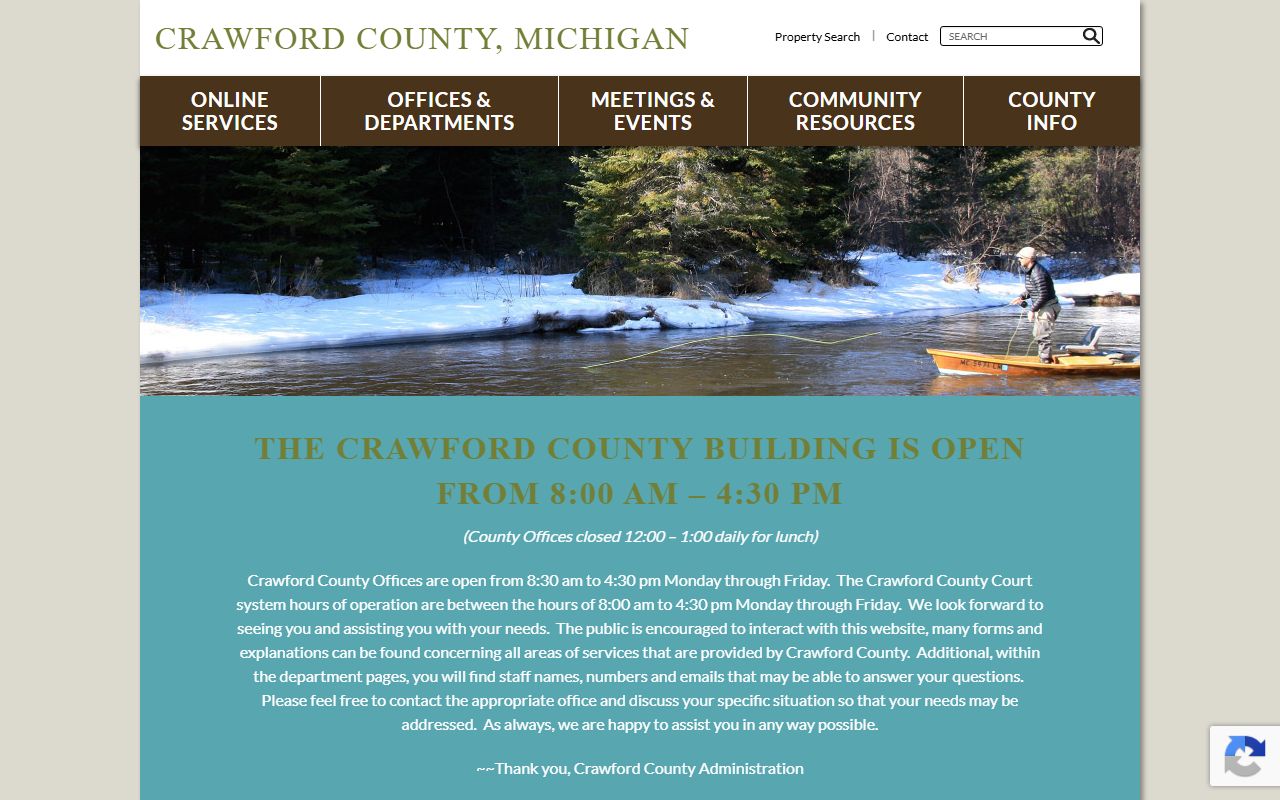
That page keeps the courts, clerk, and online-services links together, which makes it the simplest place to begin a records hunt. Follow these steps to run a basic case search:
- Open the MiCOURT Case Search portal at micourt.courts.michigan.gov.
- Enter a party name or the exact case number if you have it.
- Pick the right court, such as the Crawford circuit or probate route, to narrow the list.
- Open the matching case and review the docket entries and hearing dates.
- Call the holding division to request a certified copy when you need one for legal use.
Note: The statewide portal shows only what a court has published electronically, so a missing case does not always mean no file exists.
Using the MiCOURT Case Search Portal
MiCOURT is the public case-search platform for the whole state, and Crawford County links directly to it. The circuit route and the probate route each open a filtered view for local cases. The portal runs on scripts, so the search boxes load in the browser rather than in the raw page code. Even so, the visible field set is consistent across the Michigan Courts interface.
The following fields appear on the statewide case-search screen. Any one of them can start a search, though a name or case number works best.
| Search Field | Type | Notes |
|---|---|---|
| Case Number | Text | Fastest match when you know the number. |
| Party Name | Text | Last name first works best for people. |
| Attorney Name | Text | Finds cases tied to a named lawyer. |
| Bar Number | Text | State bar ID for an attorney search. |
| Lower Court | Filter | Limits results to a trial court such as Crawford. |
| Appellate Court | Filter | Targets appeals rather than trial files. |
| Submit Search | Button | Runs the query and returns the case list. |
When the portal comes up short, the county gives a clear fallback chain. Call the district clerk at 989-344-3240 for criminal, civil, small claims, and traffic hearings. Reach the probate register at 989-344-3237 for estate and guardianship matters. Ask the judicial secretary at 989-344-3260 about family, adoption, and miscellaneous hearings. For older paper files that never went digital, a county public-records request is the last stop.
The Crawford County Judicial System
Michigan builds its trial courts on three pieces: circuit, district, and probate. Crawford County maps onto that plan with one of each. The 46th Circuit Court hears felonies, larger civil suits, divorce, and personal protection orders. The 87-C District Court takes misdemeanors, traffic, small claims, and the first stage of felony cases. The probate court handles estates, guardianships, conservatorships, name changes, and mental-health commitments.
Judge Colin G. Hunter serves as Chief Circuit Judge, joined by Judge George J. Mertz on the circuit bench. Judge Monte J. Burmeister runs the family division and also serves as Chief Probate and District Court Judge. Magistrate Angie A. Cragg handles early district matters. The courts landing page below shows how the county organizes remote hearings and contacts by division.
The image comes from the county's courts landing page, which lists judge names and division phone lines.
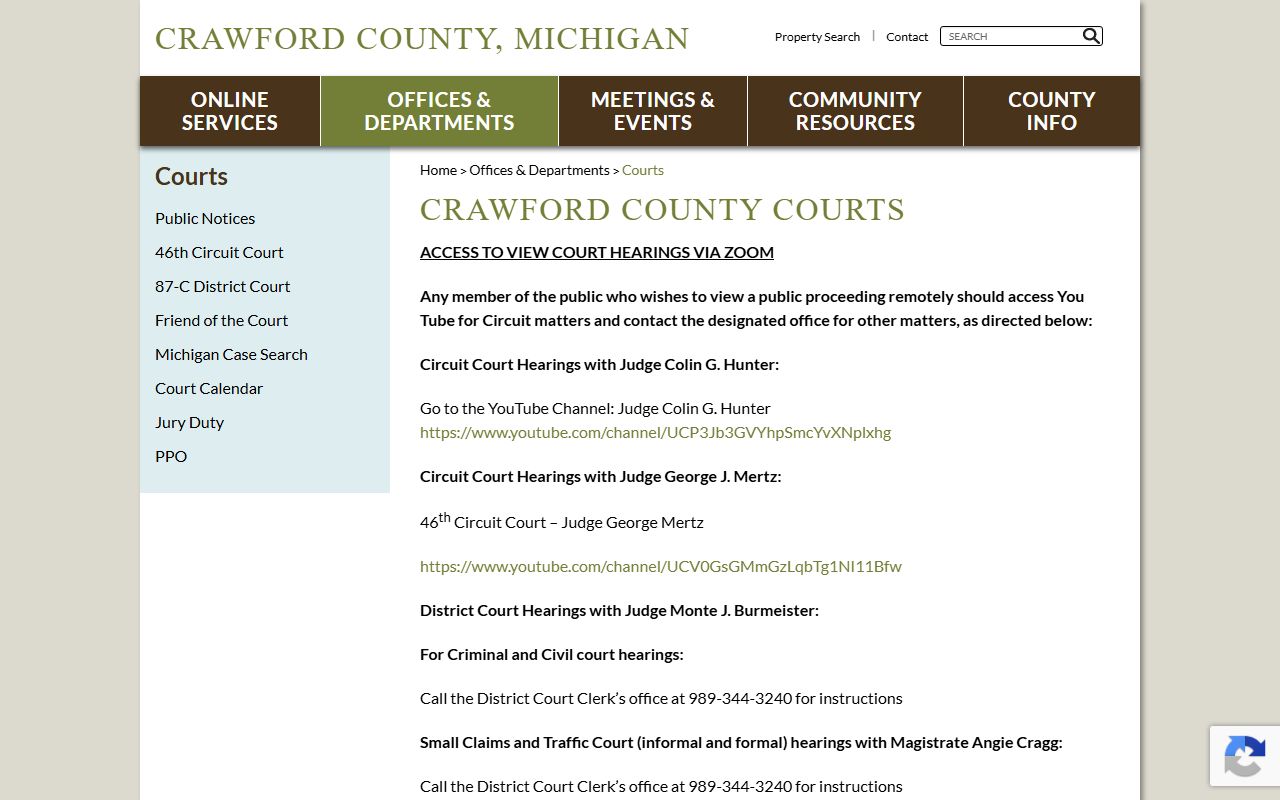
That page routes each hearing type to a specific office rather than one universal desk. Appeals from these trial courts follow a fixed ladder in Michigan.
Case flow: District Court › Circuit Court › Michigan Court of Appeals › Michigan Supreme Court
| Court | Level | What It Hears |
|---|---|---|
| Michigan Supreme Court | Highest state court | Final appeals of statewide importance |
| Michigan Court of Appeals | Intermediate appeals | Appeals from trial courts |
| 46th Circuit Court | General trial court | Felonies, big civil suits, divorce, PPOs |
| 87-C District Court | Limited trial court | Misdemeanors, traffic, small claims |
| Probate Court | Specialized trial court | Estates, guardianships, commitments |
Circuit, District, and Probate Courts Compared
The three trial courts sound alike, but each holds a different set of files. Felonies start in the district court for arraignment and then move up to circuit after a bindover. Civil money cases split at $25,000, with the smaller claims staying in district court. Probate keeps its own track for wills, estates, and protective arrangements. Knowing which court holds a file tells you which phone line to call.
The Crawford circuit route on the statewide portal opens the local case list. The screenshot below is the MiCOURT statewide case search, the entry point the county links for its trial courts.
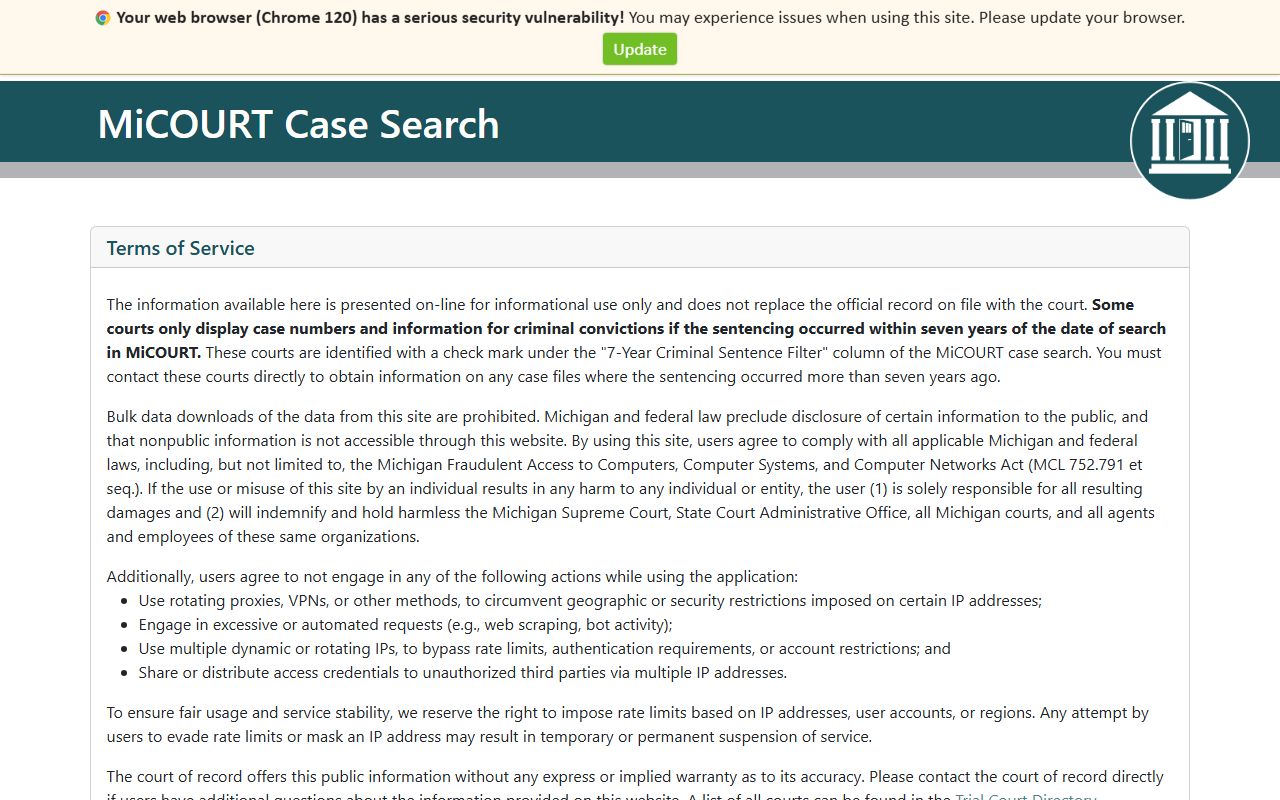
From that single portal a reader can reach circuit, district, and probate cases. The table below lines up the three courts side by side.
| Feature | 46th Circuit | 87-C District | Probate |
|---|---|---|---|
| Main matters | Felonies, divorce, PPOs | Misdemeanors, traffic | Estates, guardianships |
| Civil money range | Over $25,000 | Under $25,000 | Not money based |
| Criminal role | Trial after bindover | Arraignment and exam | None |
| Records phone | 989-344-3206 | 989-344-3242 | 989-344-3237 |
Crawford County Courthouse Divisions
Crawford County keeps one courthouse building at 200 W. Michigan Avenue in Grayling. The 46th Circuit Court, the 87-C District Court, the probate court, the family division, and the Friend of the Court all work out of that address. What changes from division to division is the phone number and the office hours, not the street. That layout makes the Grayling courthouse the practical hub for county court access.
The county's courthouse-location page below repeats the same address for every division and lists the building hours. The image is drawn from the official courthouse location page.
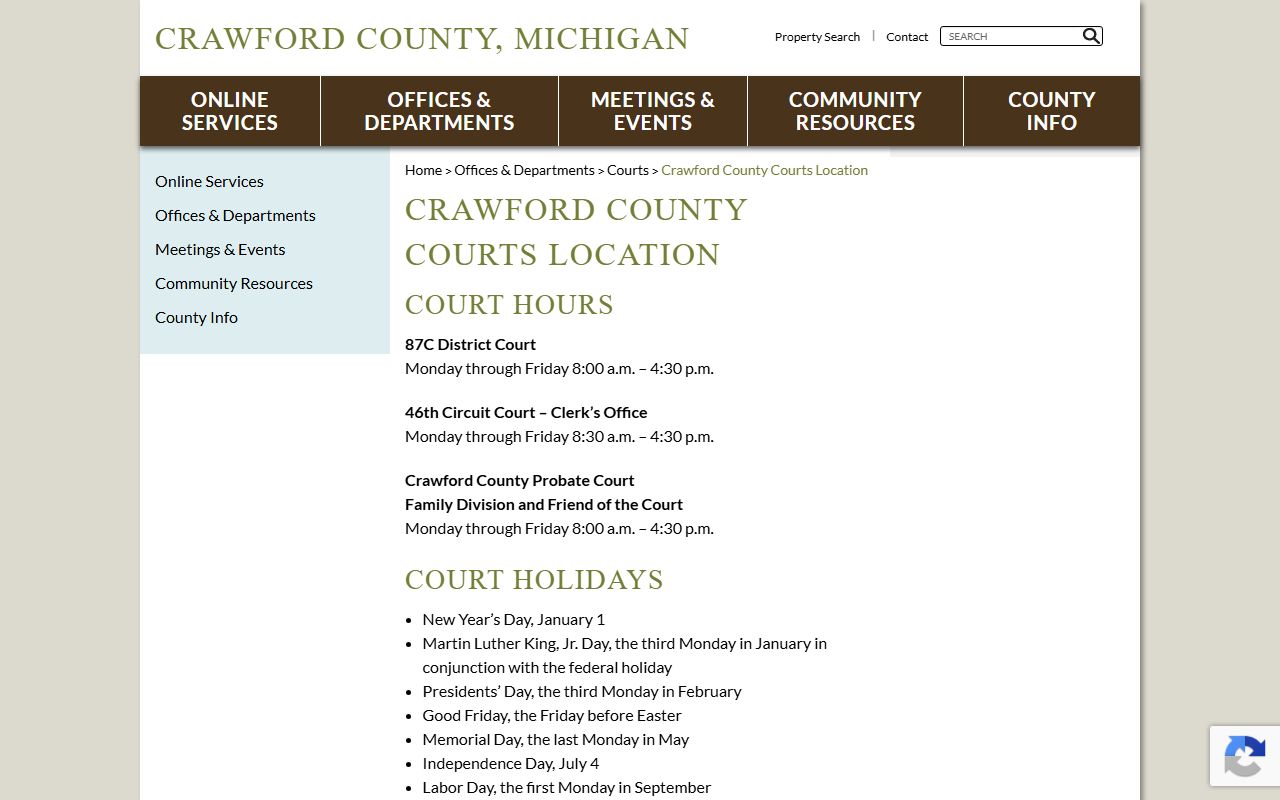
Each division answers a different line even though they share the same lobby. The cards below give the direct contact for each records desk.
Types of Court Records Available in Crawford County
Crawford County court records span every kind of case the local courts handle. Criminal files start in the district court and move to circuit for felonies. Civil files split by dollar amount, and family files cover divorce, custody, support, and adoption. Probate holds estates and guardianship matters, while traffic files sit in the district court. Vital and land records live on the clerk side of the courthouse.
The state trial-court structure shapes which office produces each record. The screenshot below comes from the Michigan Courts trial courts page, which explains the circuit, district, and probate design.
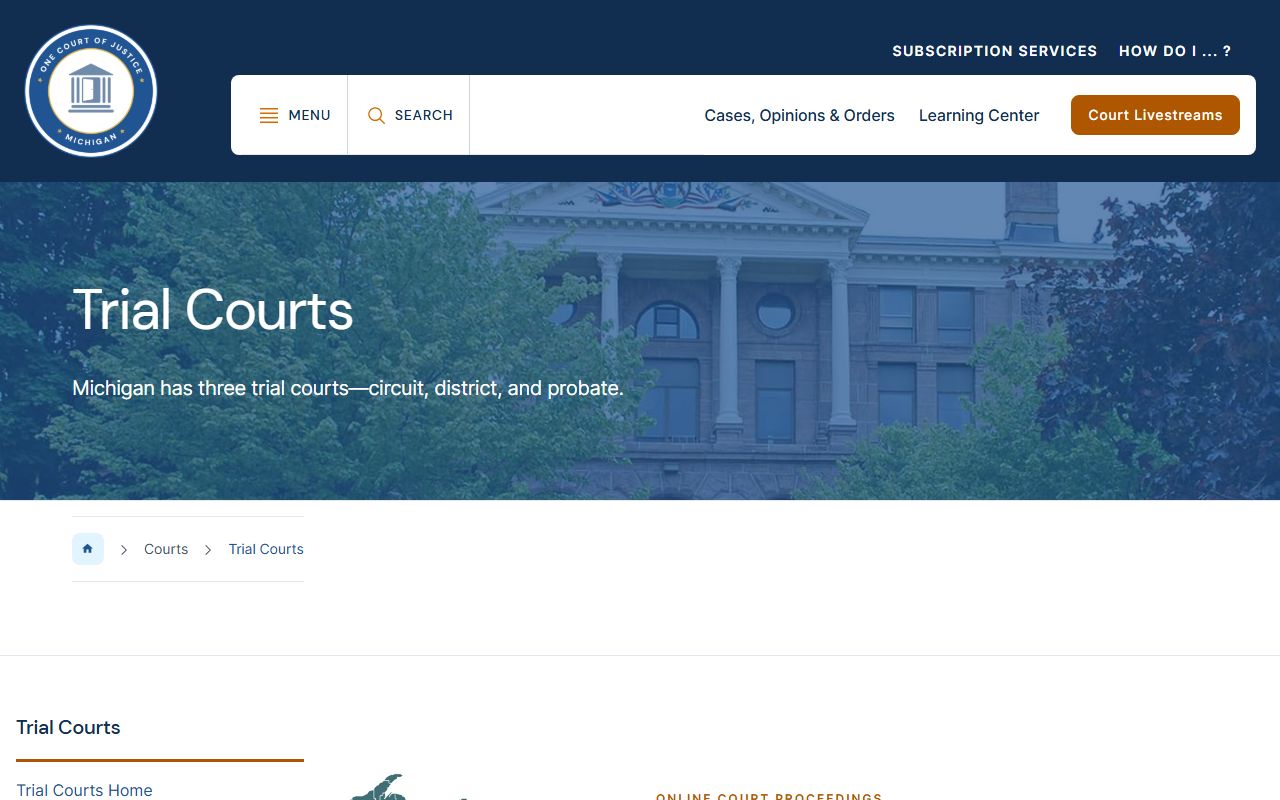
That statewide framework tells a searcher which court to expect for a given record. The main record groups break down like this:
- Criminal records - misdemeanors in district court and felonies in circuit court after bindover.
- Civil records - small claims and suits under $25,000 in district, larger suits in circuit.
- Family and divorce records - divorce, custody, support, and adoption in the circuit family division.
- Probate records - estates, guardianships, conservatorships, and name changes.
- Traffic records - civil infractions and misdemeanor traffic in the 87-C District Court.
What Crawford County Court Records Show
A Crawford County court record is more than a name and a charge. Each file carries a case number, the parties, the case type, and the key dates. Docket entries track every motion, hearing, and order along the way. Bond terms, the assigned judge, and the final disposition round out the picture. Michigan court rules set what stays public and what gets held back.
The table below lists the common fields a public case record shows. It works as a quick guide to reading a result from the portal or the clerk.
| Field | What It Shows |
|---|---|
| Case Number | The unique ID assigned when the case opens. |
| Party Names | The plaintiff, defendant, or petitioner and respondent. |
| Case Type | Criminal, civil, family, traffic, or probate. |
| Filing and Hearing Dates | When the case was filed and when it is set for court. |
| Judge or Magistrate | The judicial officer assigned to the matter. |
| Bond Information | Cash, surety, or personal bond terms where set. |
| Charge or Cause | The offense charged or the reason for a civil suit. |
| Disposition | The outcome, such as a plea, verdict, or dismissal. |
Public Access Laws for Crawford County Court Records
Michigan treats public access to government records as the default. The state Freedom of Information Act opens most county records unless a specific exemption applies. Court files sit under a separate set of rules, the Michigan Court Rules, which govern access to case records. For most readers the practical question is simple: will the office release the file without a court order? The county FOIA page handles requests that fall outside the court and vital-records channels.
Court records themselves fall under MCR 1.109 and MCR 8.119, the access rules in the Michigan records-management framework. Those rules say electronic court documents must be as available as the paper file at the courthouse. The screenshot below is drawn from that state records-management page.
That page frames the balance between open access and protected data. The statutes below are the ones that shape a Crawford County records request.
Key Statutes:
MCL 15.231 - Michigan's FOIA makes public access the default unless a record is exempt.
MCL 15.234 - Sets the labor and copying fees a county may charge for a FOIA response.
MCL 15.243 - Lists the exemptions that let an office withhold certain records.
MCL 780.621 - Allows some convictions to be set aside through a petition process.
MCL 712A.28 - Keeps juvenile court records apart from ordinary public files.
Records That Are Restricted or Confidential
Not every court file is open. Juvenile case records, adoption files, and mental-health commitment records carry strong protection under state law. Sealed family matters and set-aside convictions also fall outside normal public view. Michigan controls juvenile records under MCL 712A.28, adoption records under MCL 710.67 and 710.68, and mental-health confidentiality under MCL 330.1748.
Viewing a sealed record usually takes a court order. A person can file a motion in the court that holds the file and ask a judge to allow limited access. An expungement, known in Michigan as a set-aside, follows its own path: confirm eligibility under MCL 780.621, file the petition in the sentencing court, and attend any hearing the judge sets. A set-aside removes the conviction from public court access but does not erase it from every government system.
Note: A county FOIA request cannot force release of a record that the court rules or a statute keep confidential, so restricted files still need a court order.
Treatment and Mental Health Court Functions
Crawford County does not run a branded drug court, veterans court, or DWI court under its own banner. What it does carry is a set of treatment and mental-health functions folded into the ordinary court structure. Those pieces live inside the family division, the probate court, and the district probation office rather than in a separate specialty docket.
Mental-health matters run through several offices at once. The family-matters page routes emergency mental-health issues, the probate court handles commitment forms on a separate track, and the prosecutor attends contested commitment hearings. The county jail lists mental-health support, peer recovery coaching, Celebrate Recovery, and a Veterans Justice Outreach program among its services. The family division is also the natural home for treatment-focused juvenile cases involving abuse, neglect, and delinquency.
Probation adds another treatment layer. The district probation office supervises probationers, runs investigations, and prepares presentence reports that can steer a person toward counseling or recovery programming. These functions do not appear on a standalone dashboard, so a reader looking for treatment routing should contact the family division at 989-344-3239 or the probate register directly.
Crawford County Sheriff and Jail
Sheriff Ryan Swope leads the Crawford County Sheriff's Office, with Undersheriff Shawn Schnoor as second in command. The office works from the courthouse address at 200 W. Michigan Avenue and answers at 989-348-4616, extension 214, on weekdays. Crime tips go to 989-344-3228 or tips@crawfordsheriff.org. The 2025 annual report counted 8,348 calls for service, which shows how busy a small rural office stays.
The county jail holds 53 beds at the same address and runs a 24-hour line at 989-348-4822. It houses pretrial detainees and people sentenced to a year or less, both male and female. There is no online jail roster, so custody checks go through the phone line, the jail email at jail@crawfordsheriff.org, or the statewide notification service. For the full roster process and booking detail, see the Crawford County inmate records page, and for outstanding warrants, the warrant records page explains the court-by-court routing.
Marriage, Divorce, and Probate Records
The County Clerk and Register of Deeds office keeps marriage, birth, death, and divorce certificate copies. A marriage license runs $20 for a county resident and $30 for an out-of-state couple, with a three-day waiting period that a judge can waive. Divorce case files, though, live on the circuit court side rather than at the vital-records desk. Probate records for estates, guardianships, and conservatorships sit with the probate register. The full detail lives on the marriage and divorce records page and the probate records page.
The clerk office is also the county's main records hub, and its page below shows the combined clerk and register setup. The image is from the official county clerk and register of deeds page.
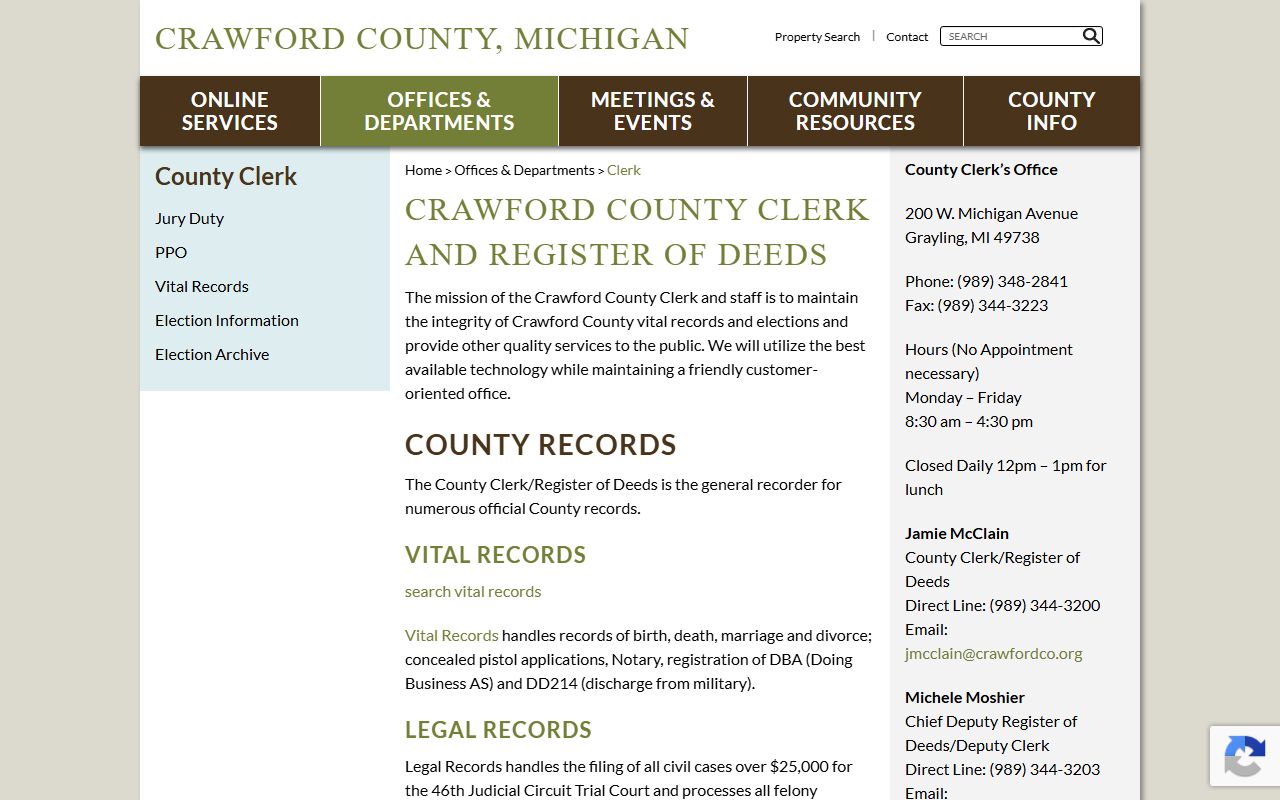
Probate uses a few terms that trip up first-time filers. The list below defines the ones that show up most.
- Testator
- The person who made a will.
- Executor
- The person named to carry out a will.
- Conservator
- Someone appointed to manage another person's finances.
- Intestate
- Dying without a valid will in place.
Crawford County Vital and Land Record Fees
Copy fees at the clerk office follow a set schedule. A first certified vital-record copy costs $15, and each extra copy of the same record at the same time costs $5. Land records carry their own search and copy prices through the register of deeds side. Payment for many services runs through GovPayNow or a check made out to Crawford County.
The table below gathers the published fees a records searcher is most likely to meet.
| Item | Amount |
|---|---|
| First certified vital-record copy | $15 |
| Each additional copy, same record, same time | $5 |
| Marriage copy priority express mail | $27 |
| Tapestry land-record search | $6.95 per name or legal description |
| Land-record copy per page | $1.00 |
| Marriage license, county resident | $20 |
| Marriage license, out-of-state | $30 |
How to Interpret Crawford County Court Records
A court record uses shorthand that can confuse a first-time reader. A charge is only an accusation, while a conviction is a finding of guilt, and the two are not the same. The disposition line tells you how the case ended, whether by plea, verdict, dismissal, or bindover. A bindover means a felony moved from district court up to circuit court for trial.
Docket entries read like a timeline. Each line marks a filing, a hearing, or an order, with the newest activity usually at the bottom. Terms like arraignment, motion, and continuance describe steps rather than outcomes. When a code or abbreviation is unclear, the clerk that holds the file can explain what it means for that case. Reading the disposition and the final judgment together gives the truest picture of where a case stands.
History of Crawford County Courts
Crawford County carries a long paper trail. The Michigan Legislature created the county in 1840 as Shawono County, then renamed it Crawford in 1843 for Col. William Crawford. County government was not fully organized until 1879, and the clerk and register of deeds office traces its records to that year. The office says it stores millions of documents, some dating back to organization.
The modern bench took shape more recently, and the county history page below sets the wider context. The image comes from the official county history page.
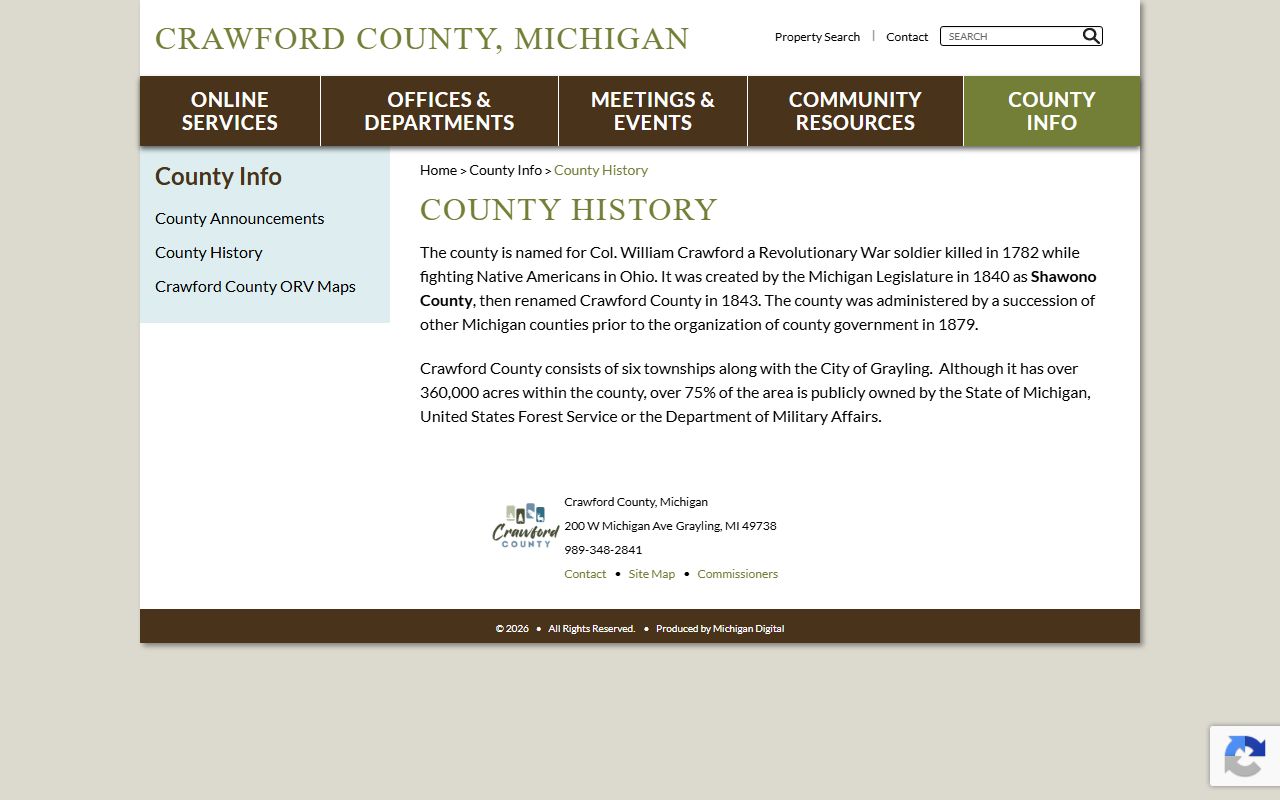
Judge Burmeister was elected in 2007, Judge Mertz was appointed in 2013, and Judge Hunter was elected in 2016. With more than 75 percent of the county held as public land and Grayling as the seat, the same courthouse address anchors nearly every court and clerk function.
Accuracy and Record Limitations
Online court records can lag behind the courthouse. A new filing, a plea, or a corrected entry may take days to reach the statewide portal. Older cases and paper-only files sometimes never appear online at all. When a record looks wrong or incomplete, the office that holds the file is the place to confirm it. The circuit clerk, the district clerk, and the probate register each maintain their own files.
Note: Confirm any court detail with the originating division before relying on it, since online records can be delayed, partial, or missing for older or sealed cases.
Frequently Asked Questions
How do I look up a Crawford County court case online?
Use MiCOURT Case Search at micourt.courts.michigan.gov, the statewide portal the county links for its trial courts. Enter a party name or a case number, then pick the Crawford circuit, district, or probate route to narrow the results. The portal shows only cases a court has published electronically. If a case does not appear, call the division that would hold it and ask the clerk to check the paper file.
Which court handles my case in Crawford County?
It depends on the matter. The 87-C District Court takes misdemeanors, traffic, small claims, and civil suits under $25,000. The 46th Circuit Court handles felonies, larger civil suits, divorce, and personal protection orders. The probate court manages estates, guardianships, conservatorships, and name changes. Felonies begin in district court for arraignment and then move to circuit court after a bindover.
Are Crawford County court records open to the public?
Most are. Michigan's FOIA and the state court rules make ordinary civil, criminal, traffic, and probate files public unless a judge seals them. Juvenile records, adoption files, and mental-health commitments carry strong protection and usually stay closed. A set-aside conviction is removed from public court access but is not erased from every government system. Sensitive identifiers like Social Security numbers are redacted from public filings.
How do I get a certified copy of a record?
Certified copies come from the office that holds the record. Vital records such as marriage certificates go through the County Clerk and Register of Deeds office, where the first certified copy costs $15 and each additional copy of the same record is $5. Court case copies come from the circuit, district, or probate clerk. Payment often runs through GovPayNow or a check payable to Crawford County.
Does Crawford County have an online jail roster?
No public online roster was found on the county site. To check whether someone is in the Crawford County Jail, call the 24-hour line at 989-348-4822 or email jail@crawfordsheriff.org. The statewide MDOC OTIS tool covers sentenced state prisoners rather than county pretrial inmates, and the VINE service offers custody notifications. The inmate records page walks through each of these channels in more detail.
What if the record I need is not online?
Start with the division that holds the file. Call the district clerk at 989-344-3240, the probate register at 989-344-3237, or the judicial secretary at 989-344-3260 for family matters. For older paper files or non-court records, file a request through the county FOIA process. FOIA cannot open records that a statute or court order keeps confidential, but it works well for public files that are simply not digitized.