
What Is a Court Docket in Crawford County
A docket is a list of cases set for hearing on a specific day. That is the plain definition the county uses, and it is the best way to picture what a docket really holds. Think of it as the court's daily schedule. Each line names a case, a time, and the type of hearing the judge will handle. The word "docket" also gets used a second way. It can mean the running list of every event and filing in a single case, sometimes called the register of actions.
Both meanings matter here. When someone asks for the Crawford County court docket, they usually want one of two things. They want the hearing calendar for a given day, or they want the event history for one case. The county's docket FAQ leans on the first sense, the daily hearing list, and it notes that the court also prepares dockets for traffic and other violation cases.
The county explains the term on its docket definition FAQ, a short reference page for the public.
That page frames the docket as a scheduling tool first, which is why most docket questions in Crawford County are really questions about a hearing date.
Docket or Calendar vs. a Full Case File
A docket and a full case file are not the same record. The docket is short. It lists events, dates, and hearing times. The full case file is the deep record. It holds the motions, orders, exhibits, and signed documents behind each of those events. Readers who only need a hearing date rarely need the whole file. Readers who need to see what a judge actually ruled will have to open the case record instead.
The difference shows up in access, too. Hearing calendars and docket entries are often quick to view. A complete case file may take a call, a visit, or a formal request. The table below sets the two side by side so the split is easy to see before you decide which one to chase.
| Docket / Calendar | Full Case File | |
|---|---|---|
| Content | List of hearings and events | Motions, orders, exhibits, transcripts |
| Length | A few lines per case | Full documents, many pages |
| Access | Calendar display or a call to the division | Office visit, clerk copy, or FOIA |
| Best for | Confirming a hearing date and time | Reading rulings and filed evidence |
For a broader look at the underlying files, the Crawford County court records page covers how the full case record is searched and copied.
Which Crawford County Courts Publish Dockets
Crawford County does not run one master calendar for every division. Instead, each court shares its schedule through the channel that fits how it hears cases. The 46th Circuit Court leans on the statewide system and on video. The 87-C District Court, the Probate Court, and the Family Division lean on direct office contact. That split is normal for a small county, and it means the right docket depends on the case type.
The circuit side is the most visible online. Crawford County exposes a court-calendar display through the MiCOURT system, and the county also streams circuit hearings on video for public viewing. The lower divisions handle scheduling through their own staff.
- Circuit Court: hearing calendar through the MiCOURT court-display link, plus live YouTube streams for Judge Colin G. Hunter and Judge George J. Mertz.
- District Court: criminal, civil, small claims, and traffic hearing dates confirmed by the district clerk.
- Probate Court: estate, guardianship, and conservatorship hearing dates confirmed by the probate register.
- Family Division: adoption, juvenile, and miscellaneous hearing dates set through the judicial secretary.
You can open the county's Crawford County court calendar display to see how circuit rows appear once the page loads. The county's main courts page lists the same routing and points viewers to video for circuit matters.
Remote Hearing Access by Division
Crawford County organizes remote hearing access by division, not through one universal link. That surprises some readers who expect a single sign-in for every court. Circuit hearings stream on video. Every other division routes access through a direct phone line staffed by the office that owns the case. To join or watch a hearing, you first match the case to its division, then use that division's channel.
The county publishes the phone routing on its courts page and its contacts-by-topic list. The table gathers the same lines in one place so you can find the right number without hunting through the site.
| Division / Matter | How to Access the Hearing | Contact |
|---|---|---|
| Circuit Court hearings | Watch by video stream | YouTube channels for Judge Hunter and Judge Mertz |
| District criminal, civil, small claims, traffic | Call for hearing instructions | 989-344-3240 |
| Family, adoption, miscellaneous | Call the judicial secretary | 989-344-3260 |
| Probate, estates, guardianship, conservatorship | Call the probate register | 989-344-3237 |
| Closed matters | Call the court administrator | Angie Cragg, 989-344-3882 |
The court contacts-by-topic page lists these direct lines by subject, which is handy when you are not sure which division holds your case. The Crawford County Circuit Court page covers the felony and major civil matters that stream by video.
Note: hearing schedules can shift, so confirm the date and access method with the division on the business day before you plan to appear or watch.
How to Find a Hearing Date
Finding a hearing date is a matter of matching the case to the right channel. Circuit cases often surface on the online calendar. Everything else usually takes a quick call to the division that owns the file. The steps below move from the fastest online option to the direct phone routing that the county relies on most.
- Identify the division. Felonies and larger civil cases sit in circuit court; misdemeanors, traffic, and small claims sit in district court; estates and guardianships sit in probate.
- For a circuit case, open the MiCOURT court-calendar display and look for the case number or party name once the page loads.
- For a district case, call the district clerk at 989-344-3240 for the hearing date and instructions.
- For a probate case, call the probate register at 989-344-3237; for family or adoption matters, call the judicial secretary at 989-344-3260.
- Write down the case number, hearing time, judge or referee, and courtroom before the hearing day.
Having the case number ready shortens every one of these steps. A full party name works when you do not have the number, though a common name can return more than one match.
Sample Crawford County Docket Entry
A hearing docket line is compact, but it carries the details you need to show up at the right place and time. Each row on a daily calendar ties a case number to a scheduled hearing, the party involved, the judge or referee assigned, and the division hearing it. The sample below shows the fields a reader typically sees on a Crawford County hearing docket. The values are illustrations, not real cases, and they simply model the shape of each entry.
| Case Number | Hearing Date | Time | Party | Judge / Referee | Hearing Type | Division |
|---|---|---|---|---|---|---|
| 24-XXXX-FH | Mon, Sep 8 | 9:00 a.m. | People v. Doe | Judge Hunter | Pretrial conference | Circuit |
| 24-XXXX-CZ | Tue, Sep 9 | 1:30 p.m. | Smith v. Roe | Judge Mertz | Motion hearing | Circuit |
| 25-XXXX-SC | Wed, Sep 10 | 10:00 a.m. | Lee v. Park | Magistrate Cragg | Small claims | District |
| 25-XXXX-GA | Thu, Sep 11 | 11:00 a.m. | In re Estate of Reed | Judge Burmeister | Guardianship review | Probate |
Read the row left to right and it answers the practical questions. Whose case is it, when does it start, who hears it, and which counter to visit inside the Grayling courthouse. The hearing type also hints at the stage of the case, from an early pretrial to a final review.
Docket Entries Readers See
Open a single case and the docket becomes a timeline. Each entry marks something that happened, a filing, an order, a hearing, or a scheduling notice. The labels can look like shorthand at first. A short glossary clears up the terms that show up most often on a Crawford County docket.
- Arraignment
- The early hearing where a defendant hears the charge and enters a plea.
- Motion
- A written request asking the judge to rule on a point before or during a case.
- Continuance
- An order that moves a hearing to a later date.
- Referee
- A court officer who hears certain family and juvenile matters and makes recommendations.
- Disposition
- The outcome that closes a charge or claim, such as a plea, verdict, or dismissal.
Alongside those events, a docket usually shows the case number, the party names, the case type, the assigned judge or magistrate, and the bond information where a criminal matter applies. Michigan court rules also require the court to protect Social Security numbers and other sensitive identifiers, so those details are kept out of the public view even when the rest of the entry is open.
The county tracks the same fields whether the case is civil, criminal, traffic, domestic, or probate. Reading them in order gives a clean picture of how far along a case sits and what the next hearing will decide.
Finding Older Hearing Notices
Some docket questions reach back past the current calendar. Maybe a hearing already happened, or a case has been closed for years. Crawford County keeps a court public-notices page that gathers jury-trial notices, phase-change notices, and annual court-review items in one archive. It is the first place to look for older hearing-related notices that are no longer on a live calendar.
The court posts these items on its court public notices page, which functions as a running record of past court announcements.
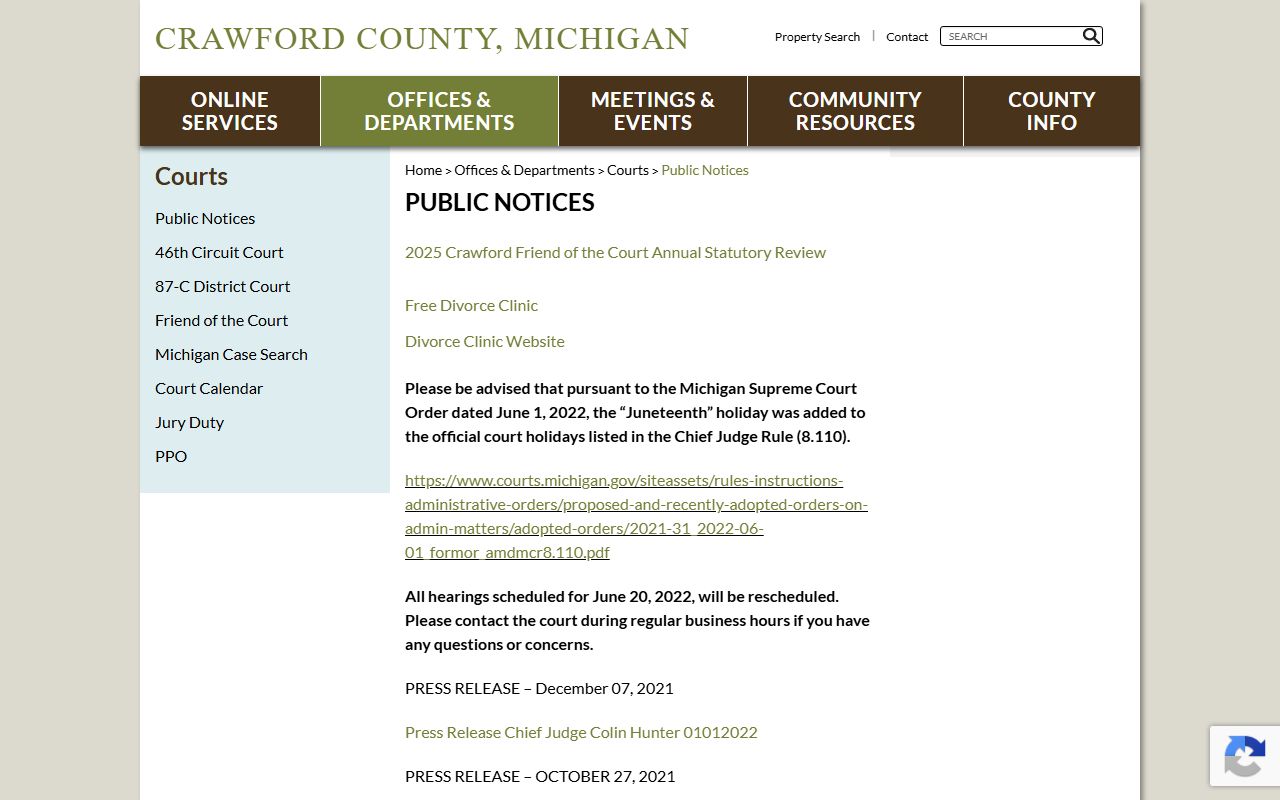
That archive leans toward jury-trial notices and annual reviews rather than a full hearing history, so it will not replace a case file. When the notice you need is older, on paper, or never posted online, the county's Freedom of Information Act process is the fallback. A written FOIA request to the county lets you ask for non-digitized or archived court records that the public pages do not carry.
You can start that request through the county's FOIA request hub, which provides the form, cost worksheet, and appeal steps. Michigan's Freedom of Information Act, set out at MCL 15.231, makes disclosure the default unless a record is exempt, which is why the FOIA route works well for older paper hearing files.
Tip: For a case still moving through court, skip the archive and call the division directly, since staff can confirm the next hearing faster than any posted notice.