
Criminal Court Records in Crawford County
A criminal court record is the official case file a court builds after a prosecutor files charges. In Crawford County, the file starts with the charging document and grows with every filing, order, and hearing that follows. The clerk keeps the record, indexes it by case number, and preserves it after the case closes. It is a case-level record, so it holds far more than a single arrest entry. Charges, bond decisions, motions, the plea, the verdict, and the sentence all live in one place. That is what makes the court file the fullest public account of a criminal case.
Two trial courts handle criminal matters here. The 87-C District Court takes misdemeanors and the early stage of every felony. Felonies begin in district court for arraignment and a preliminary examination, then bind over to the 46th Circuit Court once a judge finds enough evidence to proceed. Bindover simply means the case moves up to the higher court for trial. The county prosecutor, Sierra R. Koch, reviews and authorizes the charges that open these files. Serious cases become circuit court records, while lower-level offenses stay in the district court system.
The county explains how criminal cases move through the local courts on its criminal matters page.
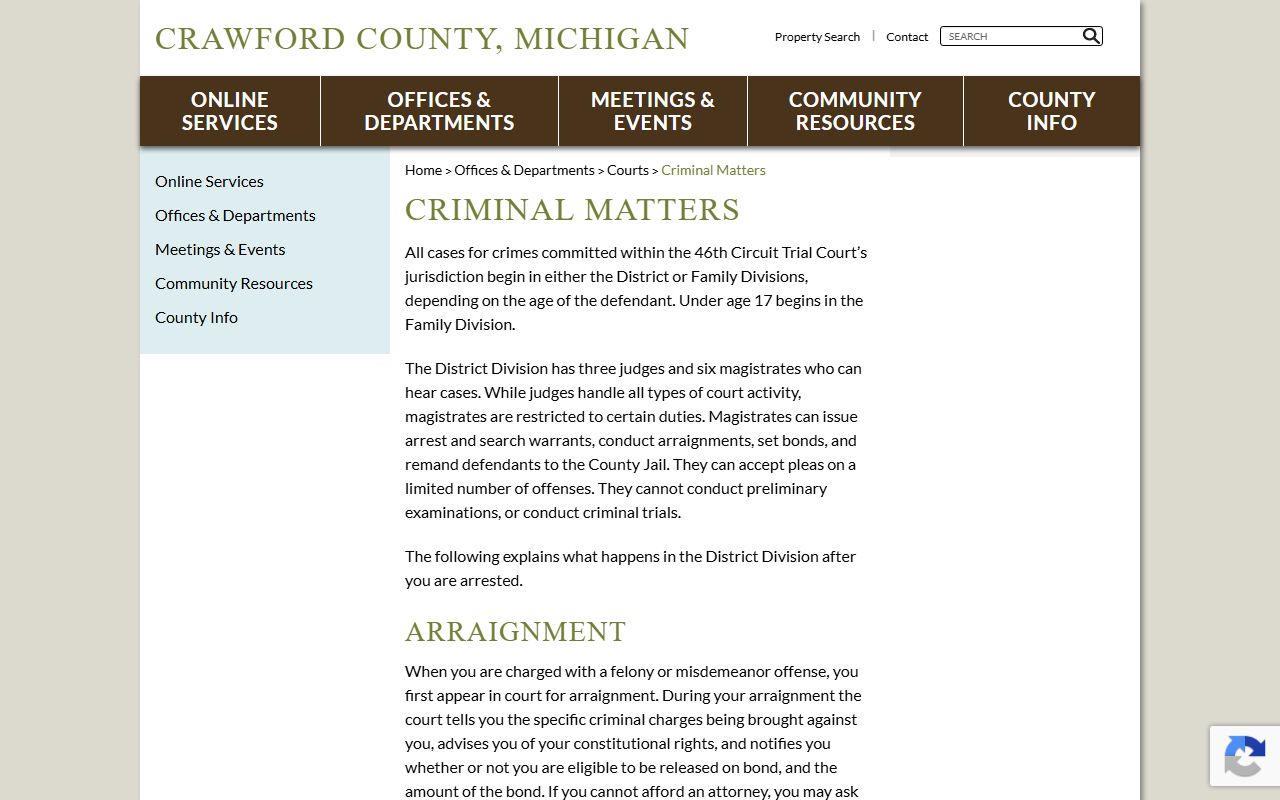
That page confirms the district court handles the first arraignment, bond, and preliminary steps before a felony ever reaches the circuit bench.
How to Search Crawford County Criminal Court Records
Most Crawford County criminal court records are searched through Michigan's statewide case portal. The MiCOURT system covers circuit, district, and probate cases across the state, and that includes criminal files from the 46th Circuit and the 87-C District Court. The portal is the fastest way to find a case by name or number, though it does not always show every older paper file.
- Open the MiCOURT case search and choose the Crawford County circuit route for felonies or the district route for misdemeanors.
- Search by defendant name, or enter the case number if you already have it.
- Narrow the results by court, case type, and filing date to find the right file.
- Open the case to read the register of actions, the charges, and the disposition.
- Ask the clerk for a certified copy when you need a court-accepted version of the record.
Some records will not appear online. For those, call the district court clerk at 989-344-3242 for criminal case questions, or file a county records request when the file is old or not digitized. Sentenced state prisoners can also be traced through the MDOC OTIS offender lookup, which covers people serving time under state supervision rather than county pretrial detainees. The county's older legacy criminal matters page still maps how felonies and misdemeanors route through the local courts.
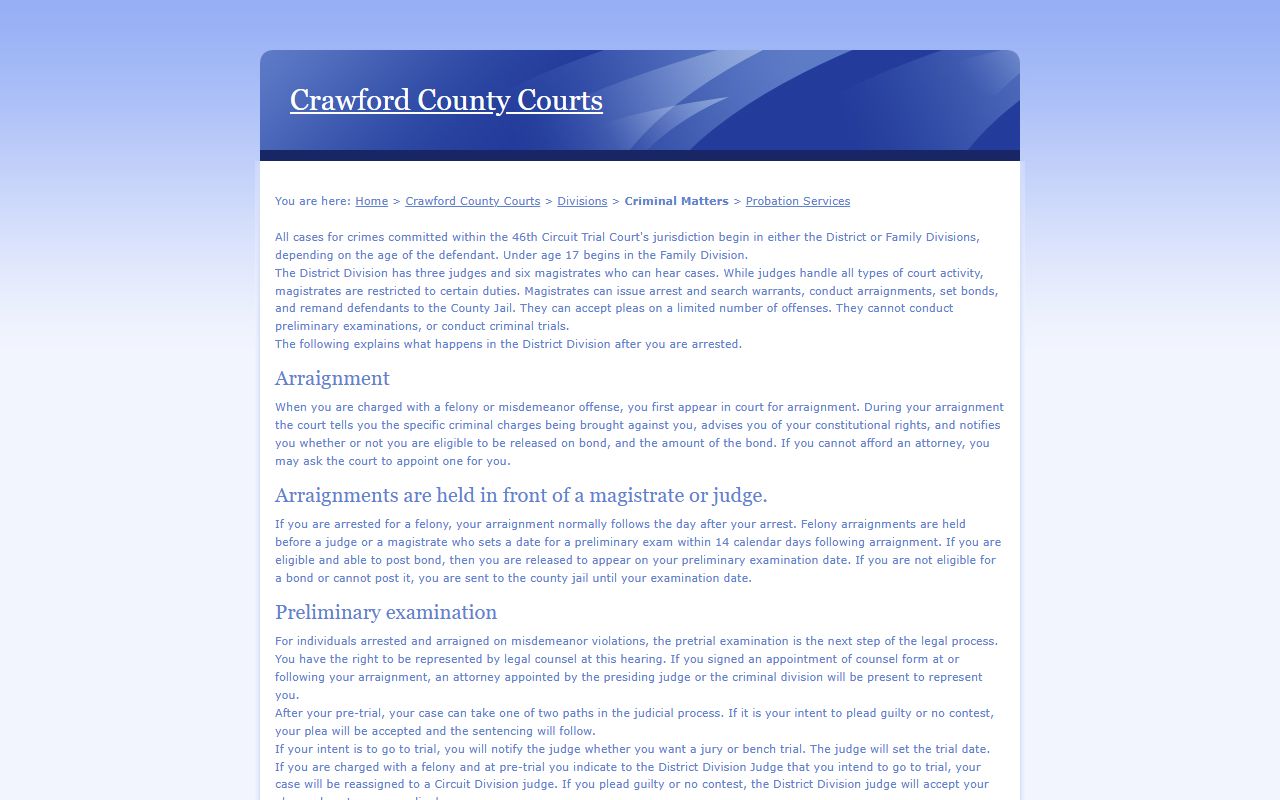
That legacy page is useful for knowing which court likely holds a file before you start a name search.
Stages of a Criminal Case
A criminal case moves through set stages, and each one adds to the record. The docket entries track this path step by step, so the file reads almost like a timeline of the case. Knowing the stages helps you read where a case stands and what happened at each point.
Case flow: Charges Filed › Arraignment › Pretrial / Motions › Plea or Trial › Disposition › Sentencing
In the early district-court phase, a magistrate carries real but limited power. Magistrate Angie A. Cragg can issue arrest and search warrants, set bond, conduct arraignments, and remand a defendant to jail. A magistrate cannot conduct a preliminary examination or run a criminal trial. Those steps belong to a district or circuit judge.
- Arraignment
- The defendant is told the charges, advised of rights, and asked to enter a plea. The court sets or reviews bond and future dates.
- Pretrial / Motions
- Lawyers exchange evidence, argue motions, and often negotiate. A felony gets a preliminary examination in district court before bindover.
- Plea or Trial
- The case ends in a plea, or it goes to trial before a judge or jury. Guilt must be proven beyond a reasonable doubt at trial.
- Sentencing
- After a guilty plea or verdict, the judge imposes a sentence, which can include jail, probation, fines, and costs.
Note: The register of actions lists each of these steps by date, so a single case file can show dozens of entries between the first charge and the final order.
What a Crawford County Criminal Court Record Shows
The fields in a criminal case file are set by court practice and Michigan court rules. Together they tell you who was charged, what they were charged with, and how the court resolved the case. The table below breaks down the core fields a reader will see in a typical file.
| Field | What It Shows |
|---|---|
| Case Number | The unique index number the clerk assigns, used to pull and cite the file. |
| Defendant | The person charged, listed with the court division and assigned judge or magistrate. |
| Charges | Each count as filed, including the offense name, statute cited, and whether it is a misdemeanor or felony. |
| Bond | The cash, surety, or personal bond amount and any conditions of release set by the court. |
| Plea | The plea entered on each count, such as guilty, not guilty, or no contest. |
| Disposition | How each charge ended, whether by conviction, dismissal, acquittal, or reduction. |
| Sentence | The penalty imposed after a conviction, including jail time, probation, fines, and costs. |
Not every field is filled in on every case. Attorney names appear where the court records them, and some identifiers are redacted to protect personal data. Older paper files may show less structured detail than a modern electronic docket.
Charges vs. Convictions
Being charged is not the same as being convicted. A criminal court record can show charges that were later dropped, dismissed, reduced, or that ended in an acquittal. A charge is only an accusation the prosecutor has authorized. A conviction is a legal finding of guilt, entered by a plea or after a trial. Reading the disposition on each count is the only reliable way to tell the two apart.
| Charge | Conviction | |
|---|---|---|
| Stage | Accusation filed | Verdict or plea entered |
| Who Decides | The prosecutor | The judge or jury |
| Burden of Proof | Probable cause | Beyond a reasonable doubt |
| Public Record | Yes | Yes |
The prosecutor's office decides which charges to file and which to amend or drop. Prosecuting Attorney Sierra R. Koch leads that office, reachable at 989-344-3246, and the county describes its duties on the prosecuting attorney page.
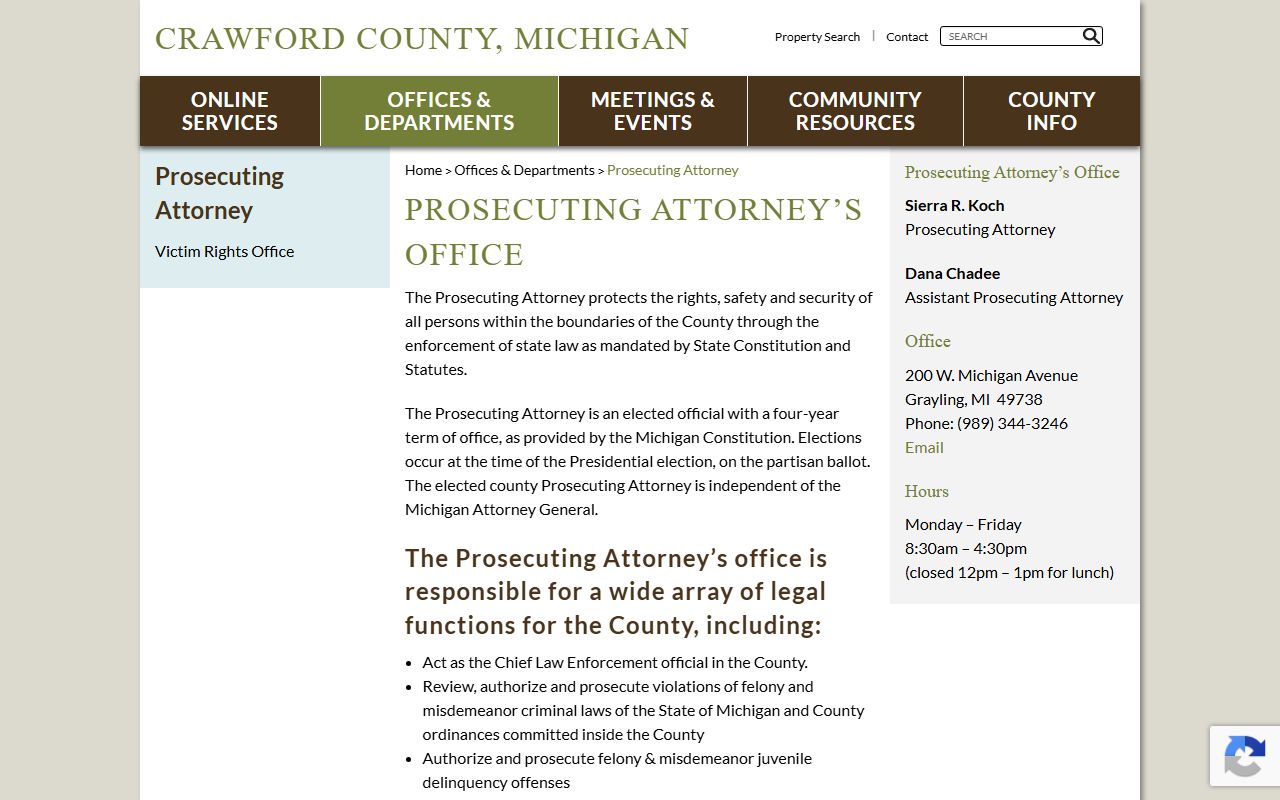
Because charges can change through the life of a case, the closer view of the charging document lives in the county arrest records and court charges pages.
Reading Dispositions and Sentences
The disposition is the heart of a criminal court record. It states how each count was resolved and, when there is a conviction, what penalty followed. Common dispositions include guilty, not guilty, dismissed, and nolo contendere, which means the defendant did not contest the charge. Some cases show a deferred or delayed outcome, where a plea is held open and can later be dismissed if conditions are met.
The sentence spells out the actual penalty. In Crawford County that can mean jail time in the county facility, a term of probation, fines, and court costs. Probation supervises a defendant in the community, and the district probation staff prepares presentence reports that help shape what the judge orders. A felony conviction from the circuit court can carry a prison term served under state custody rather than local jail.
Note: A dismissed or acquitted charge still appears in the public case file, so seeing a charge listed does not by itself mean the person was convicted.
Sealed vs. Expunged Records
People often confuse sealing a record with expunging one, but they work differently in Michigan. A sealed record is hidden from public view by a court order, while limited access can remain for the courts and law enforcement. An expunged conviction is set aside under state law, which removes it from public court access to the extent the law allows. Neither one fully erases the criminal-history footprint from every government system.
| Sealed | Expunged | |
|---|---|---|
| Visibility | Hidden from public view | Set aside, treated as removed from public access |
| Law Enforcement | Limited access | Very limited, held in restricted systems |
| How It Happens | By court order in specific case types | By petition under state law |
| Eligibility | Judge restricts access to a file or item | Set-aside allowed under MCL 780.621 after a waiting period |
Michigan's set-aside process is governed by the state expungement statute, which lists eligible offenses, waiting periods, and the petition steps that follow.
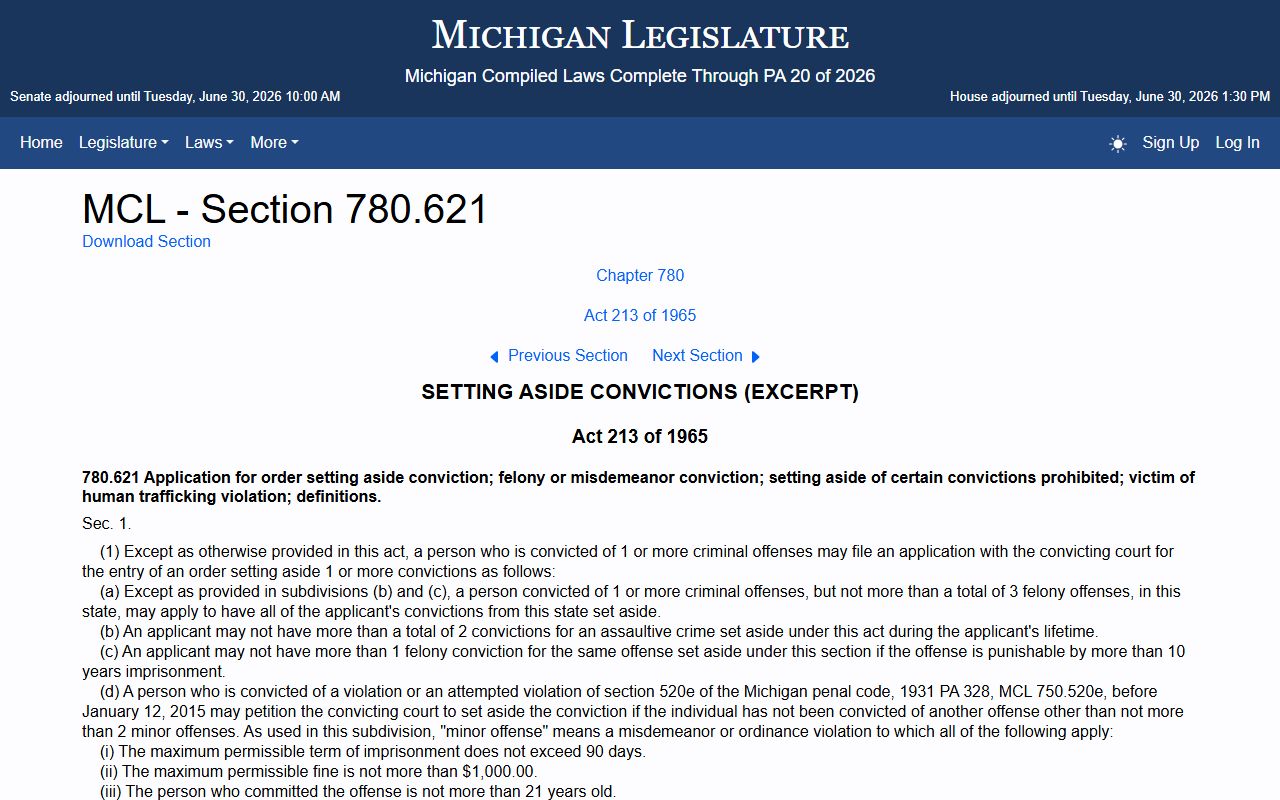
You can read the full expungement rules in MCL 780.621, which sets the limits on which convictions a court can set aside.
Public Access to Criminal Court Records
Criminal case files in Crawford County are public by default. Michigan court rules and the state open-records law together set the framework for how the public reaches these records. The rules say electronic court documents must be as available as the paper file at the courthouse, though nonpublic and limited-access items are held back. When a record is not online, a county records request is the fallback for older or paper files.
Key Statutes:
Michigan Court Rule 1.109 and MCR 8.119 govern public access to court records and how clerks maintain them.
Michigan Compiled Laws § 15.231 is the state Freedom of Information Act, which makes public records open unless a specific exemption applies.
People affected by a crime have their own point of contact through the county's Victim Rights Office, which supports victims as a criminal case moves through the courts.
That office is a helpful resource when a reader is following a case for reasons beyond a routine records search. For the wider set of civil, probate, and family files, the county's court records overview points to every division.
Background Check Considerations
A casual court-record lookup is not the same as a formal background check. A regulated background check follows federal rules and pulls verified criminal-history data for employment, housing, or credit decisions. Reading a public case file tells you what the court did, but it is not a certified history and may miss sealed or out-of-county matters. For legal purposes, always confirm the record with the clerk who holds the original.
Important: This site is not a consumer reporting agency under the Fair Credit Reporting Act, and its records must not be used for employment, tenant, credit, or insurance screening.
Restricted Criminal Court Records in Crawford County
Some criminal court records are not open to the general public. Michigan protects certain categories because of the people involved or the nature of the case. Juvenile matters are the clearest example, since they are handled through the family division and are far more restricted than adult files. Ongoing investigations, sealed items, and records a judge has limited by order can also stay out of public view.
- Juvenile delinquency records, which are closed unless a statute or court order opens a specific item.
- Set-aside convictions, which are removed from public court access after a successful petition.
- Personal identifiers, such as Social Security numbers, which are redacted from public filings.
- Sealed protective-order and family-law materials restricted by a judge.
Juvenile confidentiality is set out in the state juvenile-records statute, which treats those files very differently from ordinary public case records.
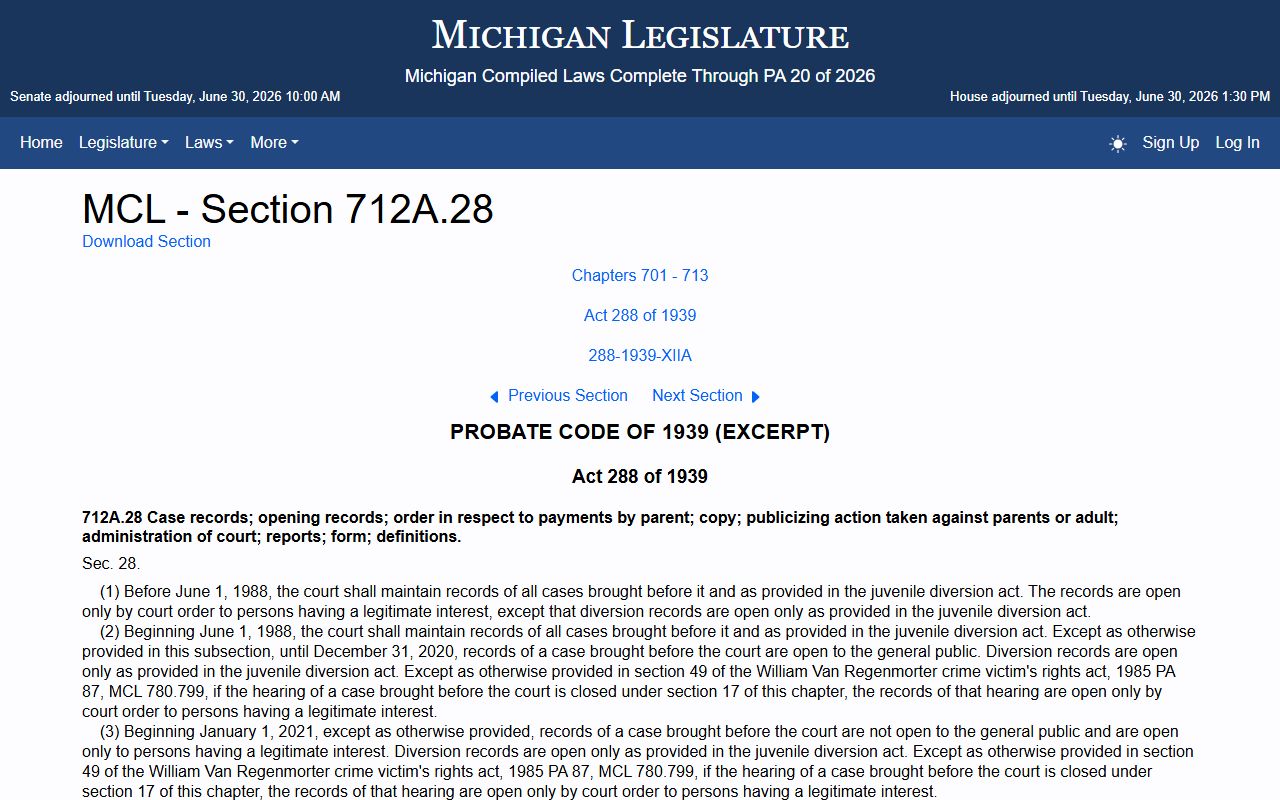
The juvenile access limits appear in MCL 712A.28. Note: A county records request cannot force release of a record the court rules or a statute keep confidential.