
No Public Warrant List in Crawford County
The starting point is the most important fact. Crawford County does not publish an active warrant list, a searchable warrant portal, or a warrant app on its official site. No county web page lets you pull up an open warrant by name. The sheriff does not post a searchable most-wanted roster either. Because of that, a warrant lookup here is a phone-and-paperwork task, not a database search. The record still exists. It simply lives with the court and the officers who handle it, not on a public web tool.
So the search follows a fallback chain. First, figure out which court issued the warrant, since that court holds the file and can confirm it. Most misdemeanor and traffic failure-to-appear warrants trace back to the district court. Felony-stage warrants after bindover sit with the circuit court, and family or juvenile matters can generate their own orders. From there you call the right clerk or register. The district court clerk answers at 989-344-3240, the judicial secretary at 989-344-3260, the probate register at 989-344-3237, and the Friend of the Court at 989-344-3272. For the arrest and booking side, the sheriff's office runs 989-348-4616 ext 214 and the jail line stays open at 989-348-4822. When a matter is public and not otherwise restricted, a FOIA request to the county or sheriff is the last resort.
Note: A bench warrant can be active even when nothing shows online, so calling the issuing court is the only reliable way to confirm one in this county.
Which Court Issued the Warrant
Every warrant question routes to a court division, so the first job is matching the matter to the right office. Crawford County shares one courthouse at 200 W. Michigan Avenue in Grayling, but the divisions inside it handle separate case types. The 87-C District Court takes misdemeanors, traffic, and small claims, which makes it the likely home for most failure-to-appear and bench warrants. The 46th Circuit Court handles felonies once a case binds over from district court. Probate and the family division run their own tracks for juvenile and related orders.
The table below routes common warrant questions to the office and phone number that can actually answer them.
| Warrant Question | Court Division or Office | Phone |
|---|---|---|
| Misdemeanor, traffic, or failure-to-appear warrant | 87-C District Court clerk | 989-344-3240 |
| Felony-stage warrant after bindover | 46th Circuit Court / judicial secretary | 989-344-3260 |
| Juvenile, guardianship, or probate-side order | Probate register | 989-344-3237 |
| Support or parenting-time enforcement | Friend of the Court | 989-344-3272 |
| Arrest, booking, or turn-in questions | Sheriff's office (ext 214) | 989-348-4616 |
| Jail-side contact for someone held | County jail line | 989-348-4822 |
Calling the wrong division wastes a little time but rarely causes harm. Staff can usually redirect you to the office that holds the file.
Warrant Terms Defined
The county keeps plain definitions of these terms in its online FAQ, and they line up with how Michigan courts use the words. A warrant, in the county's own words, is an order issued by a judge that allows police to arrest a person. That order is what turns a court's decision into an authority to detain. The labels below cover the words you will hear most when a warrant is involved.
The county spells out what a warrant is on its warrant FAQ page.
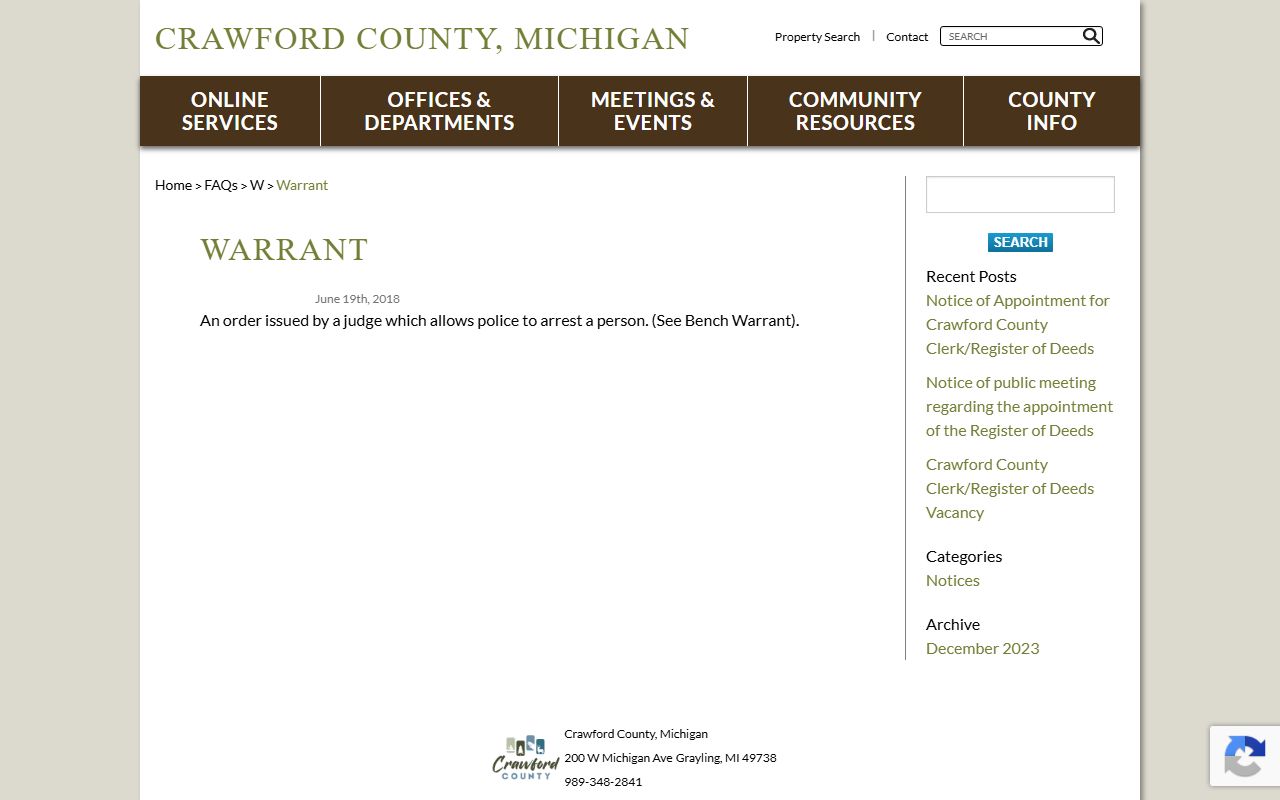
That page confirms a warrant is a judge's order, which is why a warrant search always points back to a court rather than a website.
- Warrant
- An order issued by a judge that allows police to arrest a person.
- Bench warrant
- An order issued by the court from the bench for the arrest of a person, so that person can be brought before the court.
- Warrant of arrest
- An arrest order that a judge or magistrate issues to a police officer.
- Defendant
- The person a case is brought against, named in a warrant when the court orders an arrest.
The person named in a warrant is usually the defendant, the individual a case is filed against. The county's defendant FAQ page explains that role in a court case.
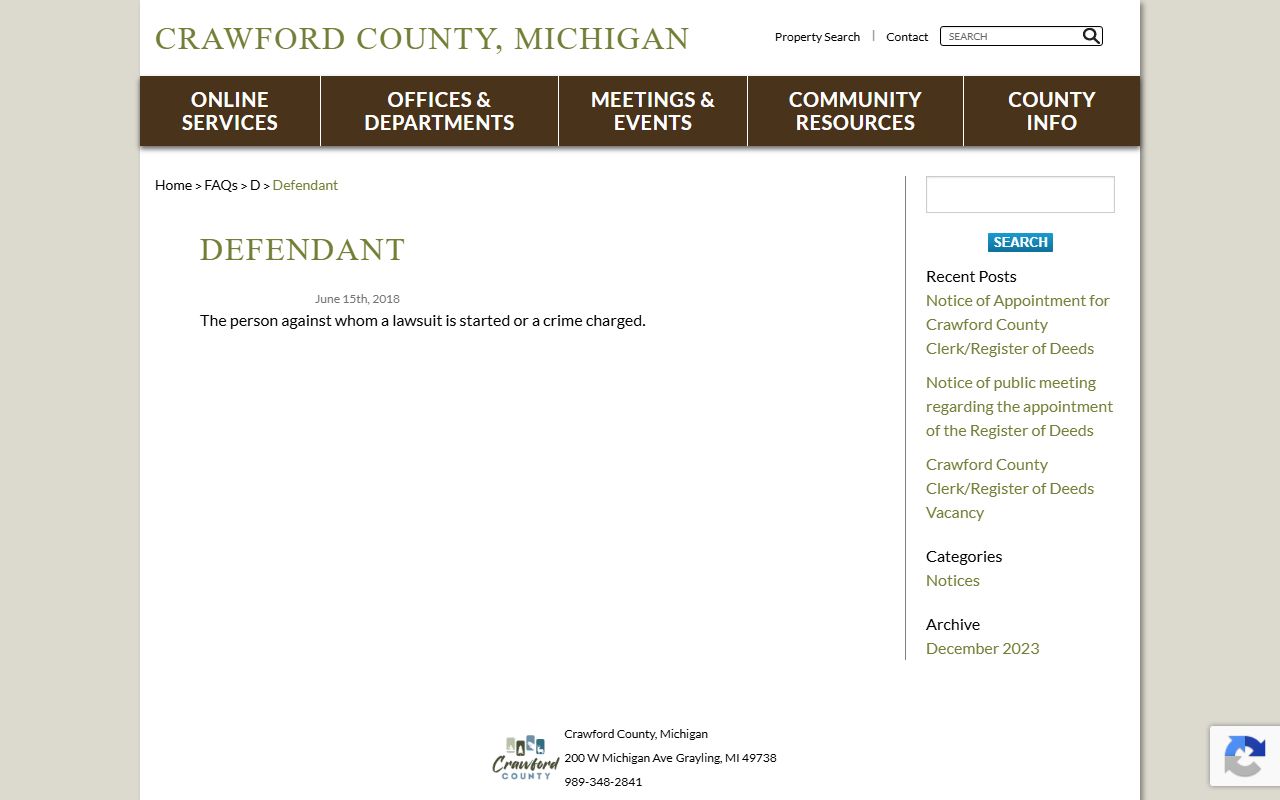
Matching the defendant's name and date of birth to the right case is what lets a clerk confirm whether a warrant is truly open.
Bench Warrant vs. Arrest Warrant
Two labels cause the most confusion, so they are worth separating. A bench warrant comes straight from the judge's bench, most often because a person missed a court date or ignored a court order. An arrest warrant, also called a warrant of arrest, is the order a judge or magistrate hands to police to bring in someone tied to a suspected crime. Both end the same way, with a lawful arrest, but they start from different triggers.
The county describes the bench warrant on its bench warrant FAQ page.
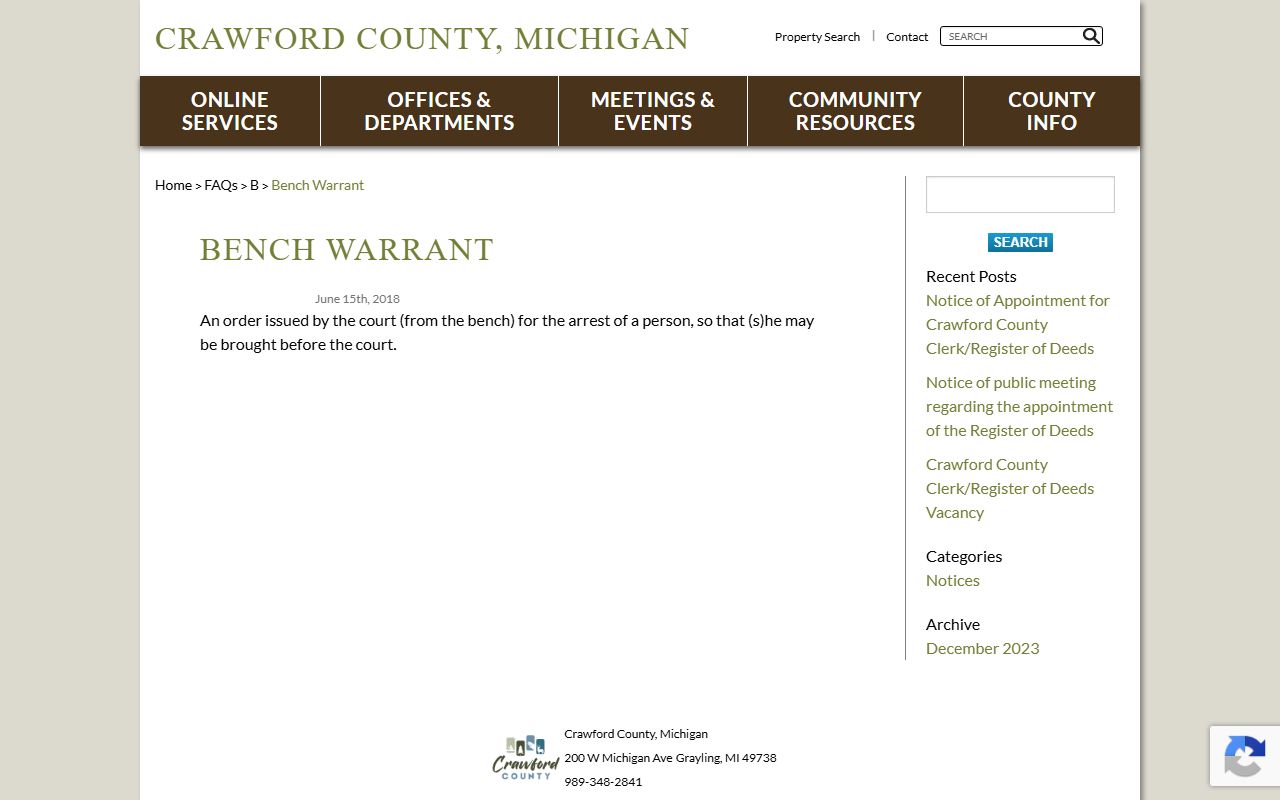
That definition makes clear a bench warrant exists to bring a person before the court, not only to punish a missed date.
| Bench Warrant | Arrest Warrant | |
|---|---|---|
| Issued By | The judge, from the bench | A judge or magistrate |
| Common Trigger | Missed hearing or ignored court order | Charge or sworn complaint |
| Purpose | Bring the person before the court | Authorize police to make an arrest |
| Typical Court | District court in many cases | District or circuit court |
Note: A single case can carry both types, as when a defendant is arrested on a charge and later picks up a bench warrant for missing the next hearing.
Types of Warrants in Crawford County
Warrants in Crawford County are best understood by how they arise, not by a fixed menu of names. The same authority, a judge's order to arrest, sits behind each one. What changes is the trigger and the court that issues it. Magistrate Angie A. Cragg, for example, can issue arrest and search warrants at the district-court level during the early stage of a case.
The county's warrant of arrest FAQ page frames the arrest order in the simplest terms.
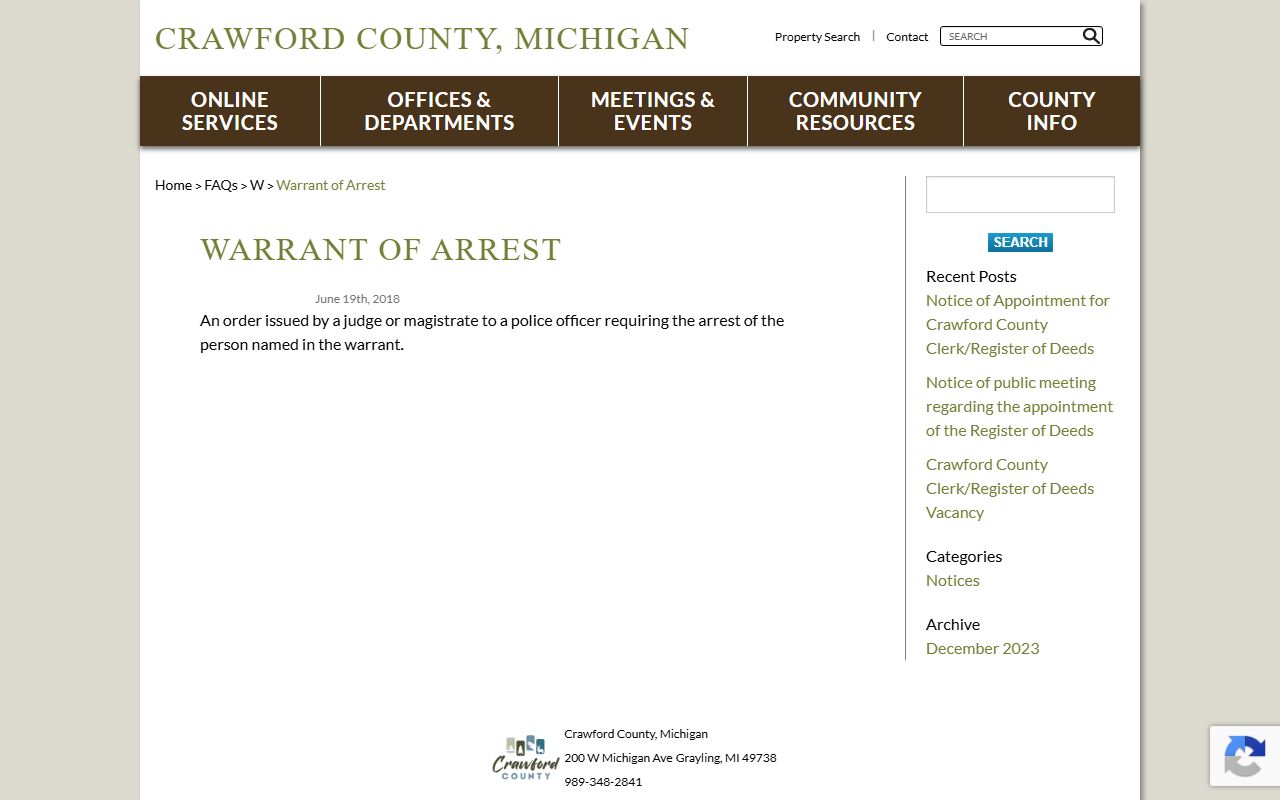
It shows that a magistrate, not only a judge, can direct a police officer to make an arrest.
- Arrest warrant - a judge or magistrate orders police to arrest someone tied to a charge.
- Bench warrant - issued from the bench when a person misses court or defies an order.
- Failure-to-appear warrant - a common district-court bench warrant for a skipped traffic or misdemeanor date.
- Felony-stage warrant - arises in the circuit court track after a felony case binds over.
- Family or juvenile warrant - the family division can issue its own warrants or contempt orders.
What a Crawford County Warrant Record Shows
When a clerk confirms a warrant, the file holds a set of standard details. These fields identify the order and tie it to a case, and they are the same facts a clerk reads back over the phone. No public web result shows them here, so the inventory below reflects what the issuing court keeps rather than what any portal displays.
| Field | What It Shows |
|---|---|
| Case or Warrant Number | The index number that ties the warrant to its court case. |
| Person Named | The defendant the warrant is issued against, with the identifiers the court uses to match a name. |
| Issuing Court and Judge | The division and the judge or magistrate who signed the order. |
| Date Issued | When the court entered the warrant, which affects how long it has been open. |
| Underlying Charge | The offense or the missed obligation that led to the warrant. |
| Bond or Bail | Any amount set for release, if the court attached one. |
| Status | Whether the warrant is open, served, recalled, or quashed. |
Not every warrant carries a bond, and some fields stay sealed when a case is confidential. A clerk confirms status in real time, which matters because a warrant can be recalled the moment the underlying issue is fixed.
What to Do If You Have an Outstanding Warrant
An open warrant does not go away on its own, and it can lead to an arrest during any routine stop. Handling it early almost always beats waiting. The safest path runs through the court that issued the order, ideally with a lawyer who can appear with you or arrange a surrender on set terms. Resolving a warrant usually means clearing the reason it was issued, such as a missed hearing, and asking the court to recall it.
- Confirm the warrant by calling the issuing court division from the routing table above.
- Ask which court date, charge, or unpaid obligation triggered it.
- Talk to a defense attorney before you appear or turn yourself in.
- Arrange to resolve the underlying issue, which may include posting bond.
- Ask the court whether the warrant can be recalled or quashed once the matter is addressed.
Important: Speak with a defense lawyer before turning yourself in, since counsel can often arrange the surrender, argue bond, and protect your rights at the first hearing.
FOIA and Public Records Fallback
When a warrant matter is public and not sealed, and the court or sheriff will not answer by phone, a formal records request is the fallback. Michigan's Freedom of Information Act treats government records as open by default unless a specific exemption applies. Crawford County runs its FOIA process through the administrator's office, with a request form, a cost worksheet, and an appeal path.
The request tools and fee rules live on the county FOIA page.
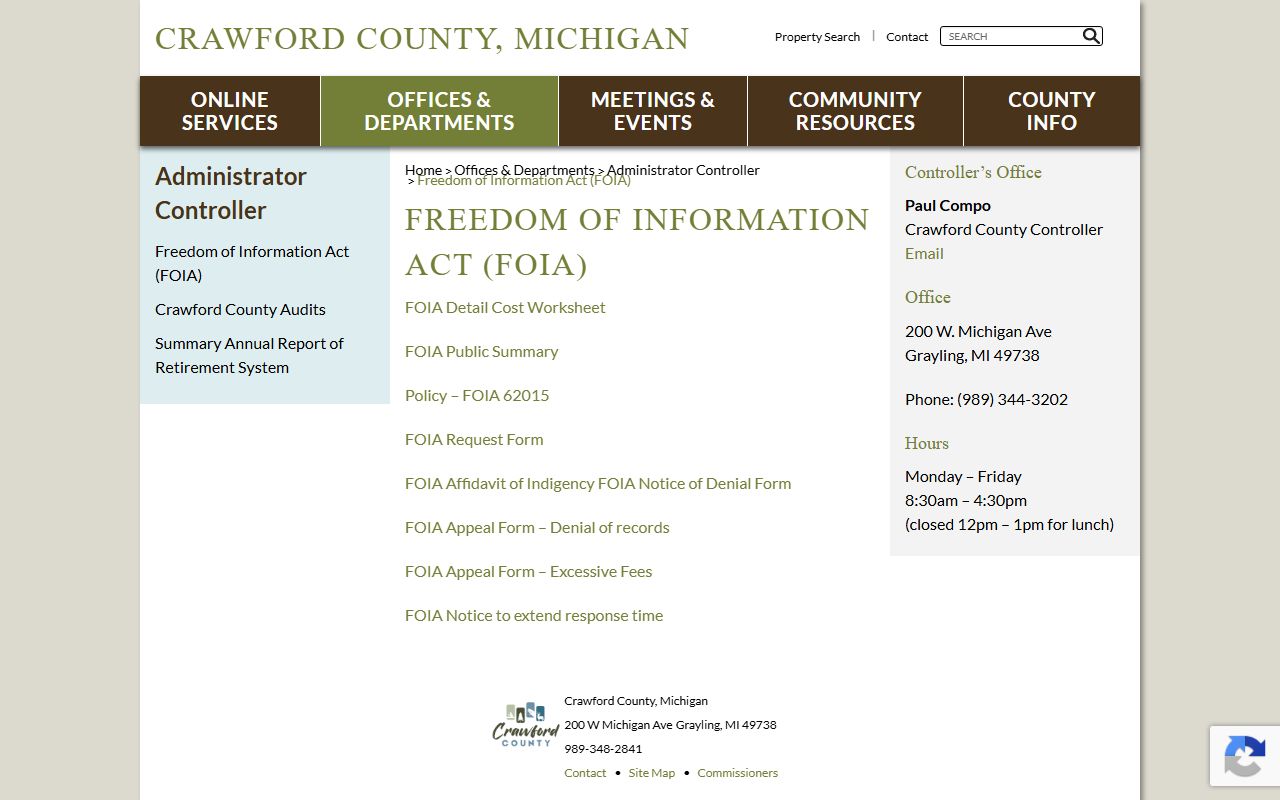
The same page hosts the request form and cost worksheet you submit when a record is not available online or by a quick call.
FOIA has limits. It cannot force release of files that court rules or statute keep confidential, and the sheriff or a judge can withhold records tied to an active investigation. The access default sits in MCL 15.231, while the list of exemptions that can block a record sits in MCL 15.243. It is worth knowing which side a warrant falls on before filing.
Note: FOIA fees can include labor and copy costs, so a broad warrant request may carry a charge the county cost worksheet spells out before the office begins the work.
Restricted Crawford County Warrant Records
Some warrant records stay out of public reach entirely. Juvenile matters are generally closed, since Michigan law shields juvenile case files from ordinary public access. Sealed family-law and protective-order materials can also carry warrants a court has restricted. Federal warrants never appear in county files at all, because they run through the U.S. courts rather than the local bench.
For someone already arrested on a warrant, the booking and custody trail shows up on the county's jail side, covered in the county inmate records. The full case a warrant belongs to, including charges and disposition, is part of the county criminal court records. A warrant is only one order inside that larger file.