
How to Search Crawford County Traffic Court Records
Traffic cases in Crawford County are heard in the 87-C District Court. Public case data is searched through MiCOURT, the statewide case-search platform run by the Michigan courts. The system covers civil infractions and misdemeanor traffic charges filed in the district division. A record can show the charge, the assigned court date, the fine, and whether the case is still open, paid, or dismissed. The county court pages link out to a district-cases display and a court calendar through the same MiCOURT system.
Gather a few details first. The citation number printed on the ticket is the fastest way in. A driver name works too, and a date of birth helps sort out common names. The portal loads through a script, so an older browser may stall. When that happens, the district clerk at 989-344-3240 can pull hearing and case details by phone.
- Open MiCOURT case search or the county's 87-C district cases display.
- Enter the citation or case number, or type the driver's full name.
- Limit the results to the district court and the ticket date to trim extra matches.
- Open the case to read the charge, the court date, the fine, and the disposition.
- Pay online, set a hearing, or ask the clerk for a certified copy of the file.
Searching by Citation Number vs by Name
Two paths lead to the same file. The citation number is unique to one ticket, so it lands on a single case with no guesswork. A name search casts a wider net and can return several people who share a name. The statewide interface is built around a case number and a party name rather than a raw ticket number, so the number on the ticket usually maps to a case number the clerk can confirm. The fields below reflect the broader Michigan case-search screen.
| Search Field | Type | Required | Notes / Format |
|---|---|---|---|
| Citation / Ticket Number | Text | No | Printed on the ticket; the clerk maps it to a case number. |
| Case Number | Text | No | Best single-case lookup once the number is known. |
| Party Name | Text | No | Enter last name first; add a birth date to narrow. |
| Attorney Name | Text | No | Finds cases tied to a listed attorney of record. |
| Bar Number | Text | No | Optional attorney identifier used in place of a name. |
| Lower Court | Menu | No | Set to the 87-C District Court for Crawford traffic cases. |
Either way, a citation number gives the cleanest result. Use a name only when the ticket is lost or the number will not read.
Which Courts Handle Traffic Cases in Crawford County
Crawford County keeps traffic simple. There is no separate municipal or justice court here. All civil traffic infractions and all misdemeanor traffic charges route through the 87-C District Court at the courthouse on West Michigan Avenue in Grayling. That single court sets the fine on an infraction, holds hearings, and takes the plea on a misdemeanor. A felony-level driving charge would begin in the same district court for arraignment and then move up to the 46th Circuit Court after bindover.
One group of drivers follows a different track. When the person cited is a minor, the traffic matter shifts out of the adult district flow and into the family and juvenile contact chain. A juvenile civil infraction and a juvenile misdemeanor are handled through the family division rather than the ordinary district traffic desk. Parents of a cited minor should call the court before assuming the standard ticket options apply.
The court also runs a short bi-weekly update on hearings and court operations, which readers can follow through the Crawford County court newsletter page. The image below shows that subscription notice.
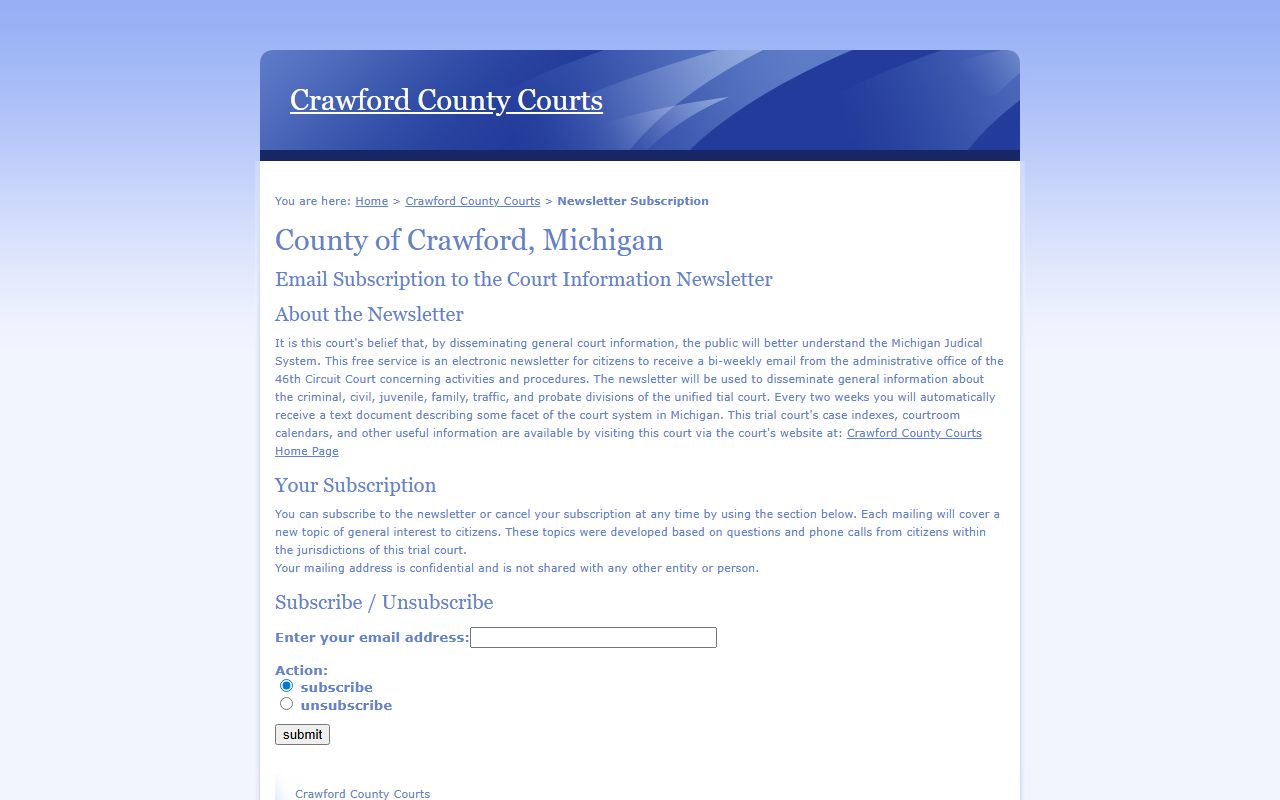
Following the court's own updates is a practical way to catch a changed hearing date on a traffic case before a missed appearance turns into a bigger problem.
Types of Traffic Cases on Record
Traffic files in the district court fall into two broad groups. Civil infractions are the everyday tickets, and they are not crimes. Misdemeanor traffic charges are criminal and carry the risk of jail. Both leave a case record the public can search. The legacy county ticket page still lays out these categories, and it is linked below with a sample view.
The legacy Crawford County traffic ticket page breaks the ticket options down in plain steps.
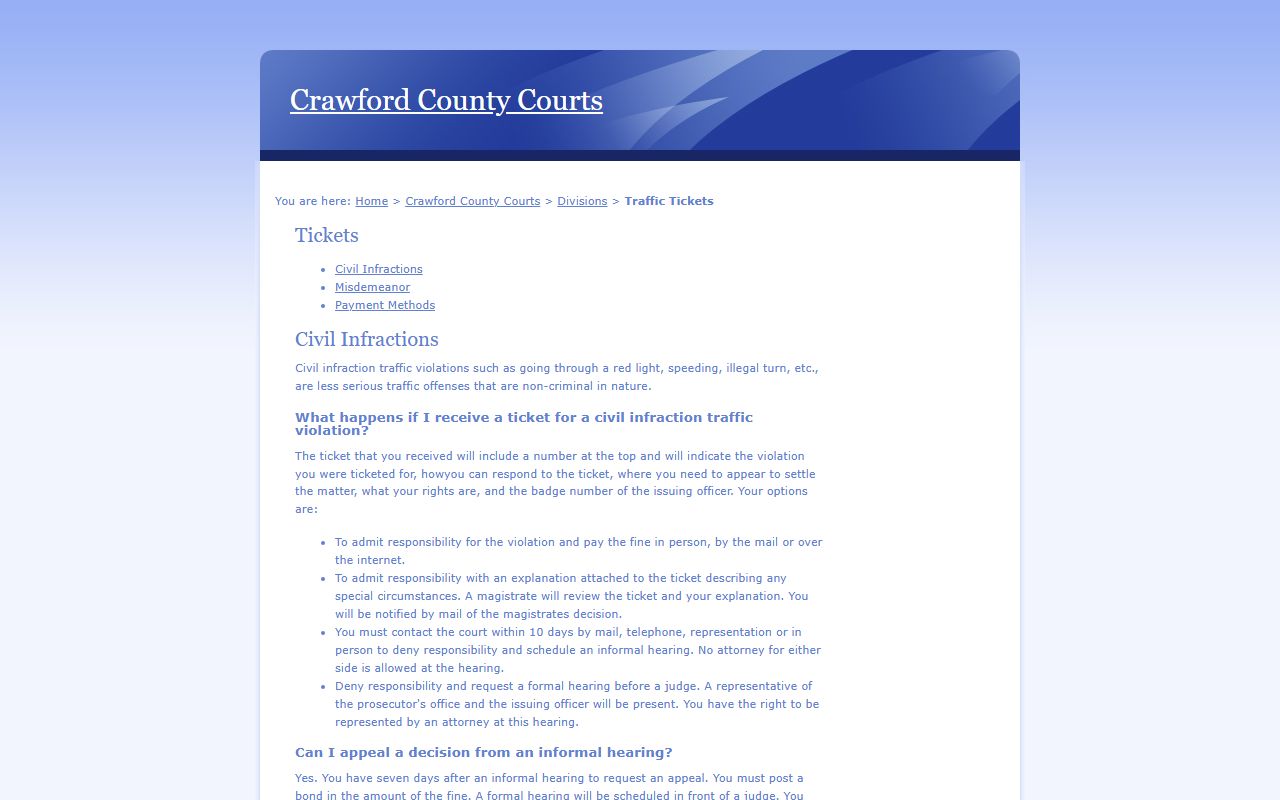
That page frames the split that shapes every traffic record in the county, shown in the list here.
- Civil infractions - non-criminal tickets such as speeding, a red-light violation, or an illegal turn.
- Misdemeanor traffic - criminal charges like drunk driving or leaving the scene of a crash.
- Equipment and non-moving - tickets for vehicle condition or a stopped-vehicle rule rather than driving.
- Juvenile traffic - a citation issued to a minor, routed through the family division.
- License-triggered matters - failures to respond or appear that add a suspension flag.
What Crawford County Traffic Court Records Show
A district traffic file reads much like any other court case. It names the driver, states the charge, and tracks each step from the ticket to the final result. The fields below are the ones a searcher sees most often on a Crawford County traffic case. Points and insurance effects are not listed here, because those belong to the state driving record, not the court file.
| Field | What It Shows |
|---|---|
| Citation Number | The unique number on the ticket that opens the case. |
| Charge / Statute | The violation cited, such as speeding or a misdemeanor traffic count. |
| Court Date | The hearing or appearance date set by the district court. |
| Disposition | How the case ended: paid, admitted, dismissed, or found responsible. |
| Fine and Costs | The dollar amount owed to the court on the case. |
| Bond | Any cash or surety bond set on a misdemeanor traffic charge. |
Note: A civil infraction shows a fine and a finding of responsible or not responsible, while a misdemeanor file adds arraignment, plea, and any jail or probation terms.
How to Pay or Contest a Traffic Ticket
A civil infraction gives the driver a real choice. You can accept the ticket and pay, accept it but explain the situation, or deny it and ask for a hearing. Michigan sets a short clock on that choice. The county traffic page describes a 10-day window to respond, and ignoring the ticket can lead to a default judgment and a suspended license. The official Crawford County traffic tickets page spells out each route.
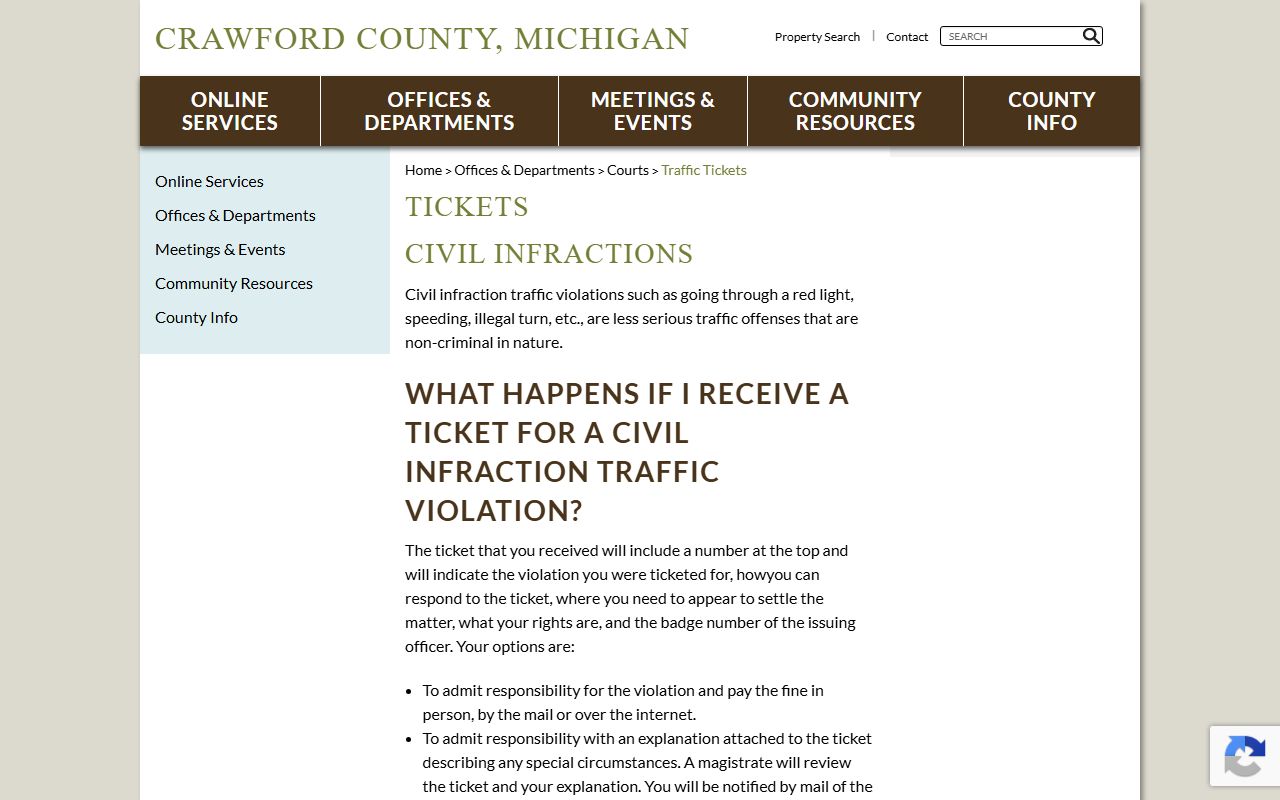
The page pictured above ties directly into the four options laid out in the steps below.
- Admit and pay. Accept responsibility for the infraction and pay the fine and costs by the deadline.
- Admit with explanation. Accept responsibility but ask the court to weigh the circumstances before setting the amount.
- Deny and request an informal hearing. Contest the ticket before a magistrate, with no lawyer required on either side.
- Deny and request a formal hearing. Contest the ticket before a judge, where lawyers may take part.
- Respond within 10 days. Choose an option and reply on time, since a missed deadline can bring a default judgment and a license suspension.
A misdemeanor traffic charge follows the criminal path instead, with an arraignment, a plea, and possible trial. Failure to appear on that kind of charge can bring a warrant on top of a suspension.
Court Traffic Records vs State Driver Records
This is the distinction that trips up most searchers. The court traffic record is the case file the 87-C District Court keeps for one ticket. The state driver record is a separate history held by the Michigan Secretary of State, and it tracks convictions, points, and license status across a lifetime of driving. A dismissed ticket may vanish from the driving picture yet still appear as a closed court case. The two files answer different questions, so the right office depends on what you actually need.
| Feature | Court Traffic Record | State Driver Record |
|---|---|---|
| Source | 87-C District Court case file | Michigan Secretary of State |
| What it shows | Charge, court date, fine, disposition for one case | Conviction history, points, and license status over time |
| Where to access | MiCOURT or the district clerk at 989-344-3240 | The Secretary of State driving-record channel |
| How to correct errors | Ask the district clerk or the sentencing court | Take the correction to the Secretary of State |
Ask for a court copy when you need proof of how a specific case closed. Ask the Secretary of State when the real concern is points, insurance, or a license flag.
Public Access Laws for Traffic Court Records
Ordinary traffic files are public in Michigan. Anyone can view a civil infraction or a misdemeanor traffic case unless a judge has sealed it. Two bodies of law shape that access. The Freedom of Information Act sets the default that government records are open, and the Michigan Court Rules govern how court files in particular are released. Older paper tickets that never went online are still reachable through a records request to the county.
Key Statutes:
MCL 15.231 - Michigan's FOIA makes access to public records the default unless a record is exempt.
MCL 15.234 - lets the county charge set labor and copying costs for a records request.
MCL 712A.28 - keeps juvenile court records out of the ordinary public file.
Note: A public traffic record still redacts sensitive data such as Social Security numbers, and juvenile traffic matters follow the tighter juvenile-access rules rather than the open district file.
DUI and Criminal Traffic Cases
Drunk driving is not an ordinary ticket. Michigan treats operating while intoxicated as a misdemeanor traffic charge, and the county page notes that misdemeanor traffic can reach a penalty of up to a $1,000 fine and up to one year in jail. These cases begin in the 87-C District Court with an arraignment and a plea, and a serious or repeat charge can climb to the circuit level. Leaving the scene of a crash follows the same criminal track.
Because a DUI produces a full criminal case file rather than a simple infraction record, the charges, pleas, and sentence live with the broader Crawford County criminal court records. Start there for the complete case history on any drunk-driving or serious traffic charge.
Juvenile Traffic Matters
A ticket handed to a driver under 18 does not stay on the adult district traffic desk. Crawford County routes juvenile traffic through the family and juvenile contact chain, whether the citation is a civil infraction or a misdemeanor. That shift matters for access as much as for procedure. Juvenile court records are far more limited than adult files, so a parent or guardian will not always find the case on the open public search.
Families with a cited minor should call the court to confirm the correct division and the hearing process. The standard four-option civil-infraction menu may not apply in the same way once the case moves into the juvenile track.
Setting Aside a Traffic Conviction
Michigan lets some convictions be set aside, which removes them from public-facing court access to the extent the law allows. The process runs through a petition filed in the sentencing court under the state set-aside statute, subject to waiting periods and offense limits. A set-aside is not the same as erasing every trace. The record can still sit in restricted government systems, and driving-related flags may follow separate rules at the state level.
Anyone weighing a set-aside on a traffic-related conviction should review MCL 780.621 for eligibility before filing. The petition goes to the same court that handled the original case, which for a Crawford County traffic misdemeanor is the 87-C District Court.
Fees, Payment, and Records Requests
The district court takes ticket and fine payments through more than one channel. The county traffic pages point drivers to an online GovPayNow link for card payments, and they accept payment in person or by mail at the district division. One warning appears clearly on the county pages: never send cash through the mail. For a copy of an actual case file, the county traffic page tells readers to contact the clerk, since a court copy is different from a driving-history question.
The legacy fines and costs page gives context for the financial side of a traffic case.
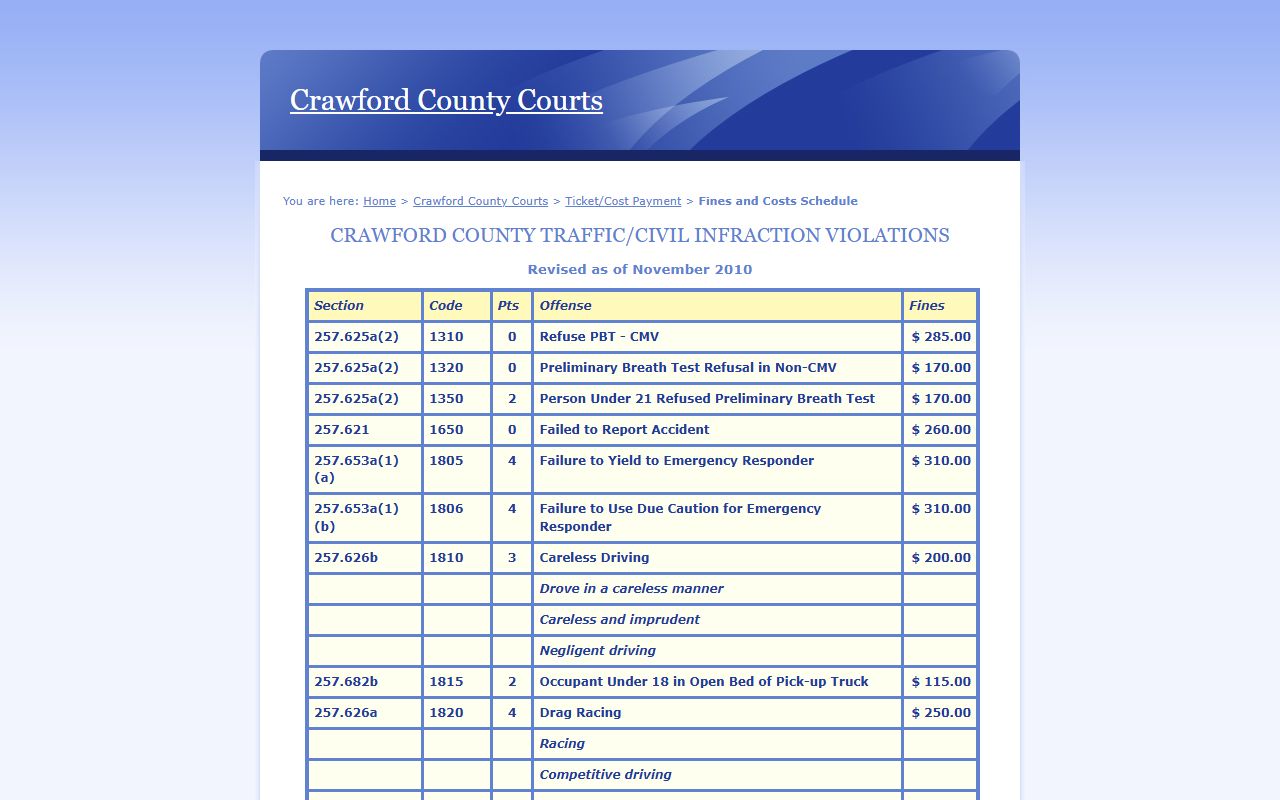
The reference above sits alongside the payment and penalty details summarized in the table.
| Item | Amount / Detail |
|---|---|
| Online ticket or fine payment | County GovPayNow card link |
| In-person or mail payment | 87-C District division; no cash by mail |
| Misdemeanor traffic maximum penalty | Up to $1,000 fine and/or 1 year jail |
| Certified copy of a traffic case file | Request from the district clerk, 989-344-3240 |
| Older paper records (FOIA) | Labor and copying costs under MCL 15.234 |
When a record is not online, a request to the county clerk or a FOIA filing is the fallback. The Crawford County clerk's office and the district division together cover the older files that MiCOURT does not display.